Bible verse wall art
Ecclesiastes 4: “A threefold cord is not quickly broken”
Ecclesiastes is the Bible's most skeptical book, and chapter 4 opens with oppression, envy and loneliness. Then, almost in passing, it offers one of the most hopeful images in the Old Testament.
Ecclesiastes 4 print
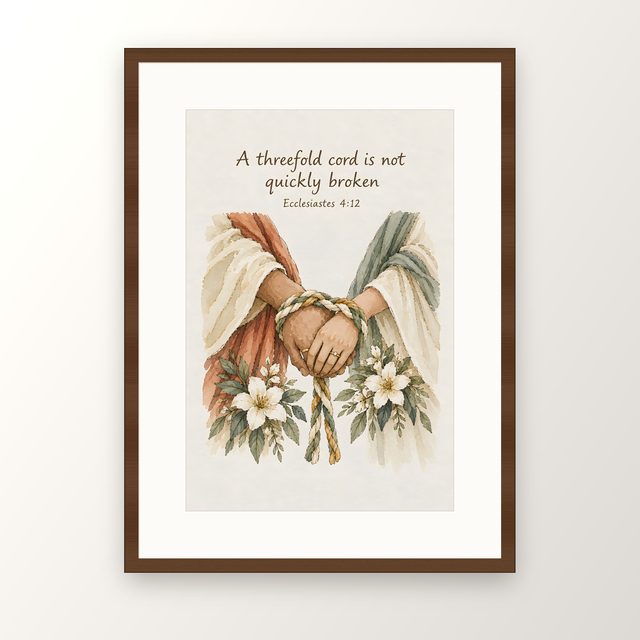
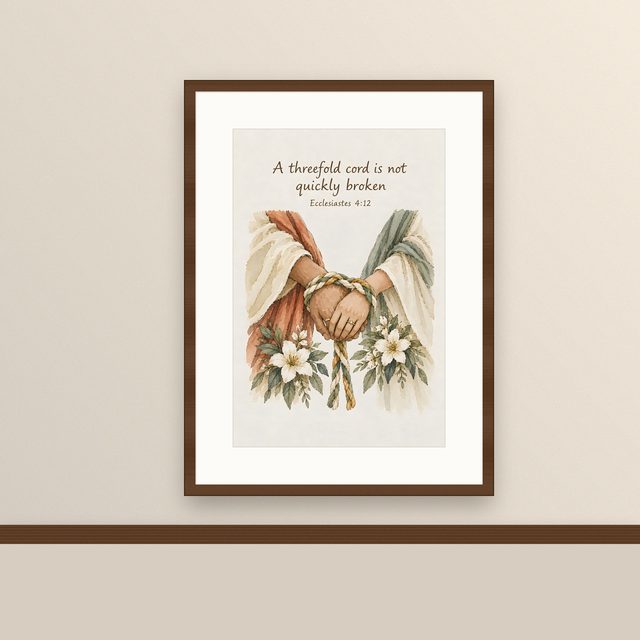
Ecclesiastes 4 · King James Version
12 A threefold cord is not quickly broken
The Preacher and his questions
The book's speaker calls himself Qoheleth, translated “the Preacher” in the King James, and presents himself as a son of David and king in Jerusalem. Jewish and Christian tradition long identified him with Solomon, while many scholars today date the book several centuries later. Its refrain, “vanity of vanities”, uses a Hebrew word that means vapor or breath: life is brief and hard to grasp.
Chapter 4 surveys human life under the sun and finds it troubling. The oppressed have no comforter. People work hard mostly out of rivalry with their neighbor. A man with no son or brother toils endlessly and never asks who he is doing it for.
What does a threefold cord mean?
Verses 9 to 12 are the Preacher's answer to that loneliness, and they are strikingly practical. Two are better than one because they get a better return for their work. If one falls, the other lifts him up. Two lying together on a cold night keep warm. And if an attacker overpowers one person alone, two together can stand against him.
Verse 12 then adds a proverb that goes one step further: a cord of three strands does not snap easily. Rope makers knew that twisting several strands together makes a line far stronger than each strand alone. The point in context is simply that companionship multiplies strength, and that more help is better still.
The Preacher does not explain the third strand, and he may not have meant anything beyond the number itself. Christian readers, especially at weddings, often understand it as God binding a husband and wife together; that is an application rather than the original sense, but a natural one.
The cord at weddings
Many couples read this passage during the ceremony, and some braid three colored cords together as a visible sign of the vow, a custom often called a unity braid. As wall art it makes a meaningful anniversary or wedding gift, and it suits friendships and business partnerships too, since the text itself speaks of any two people who stand together.
Companionship in the rest of the Bible
Genesis 2 records God saying it is not good for the man to be alone. Proverbs 27 compares friends sharpening each other to iron sharpening iron. Jesus sent his disciples out two by two (Mark 6) and promised to be present where two or three gather in his name (Matthew 18).