Bible verse wall art
Ezekiel 36: “A new heart also will I give you”
Spoken to a nation that had lost its land, its temple and its king, this chapter promises more than a return home. It promises a change on the inside.
Ezekiel 36 print
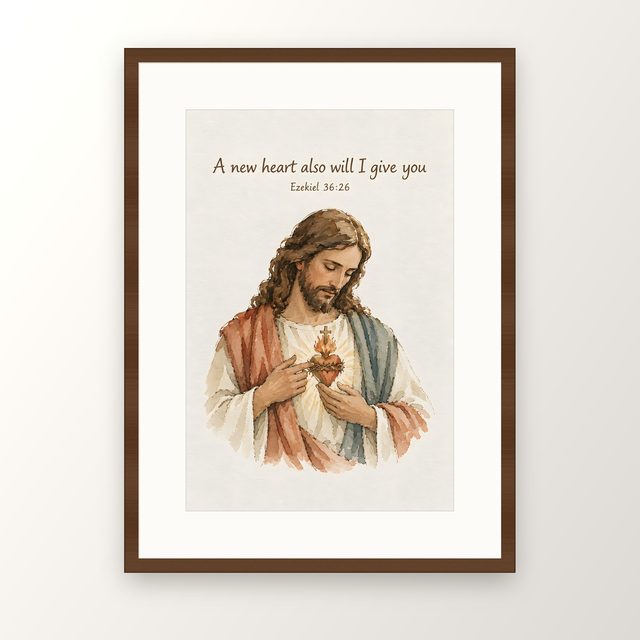
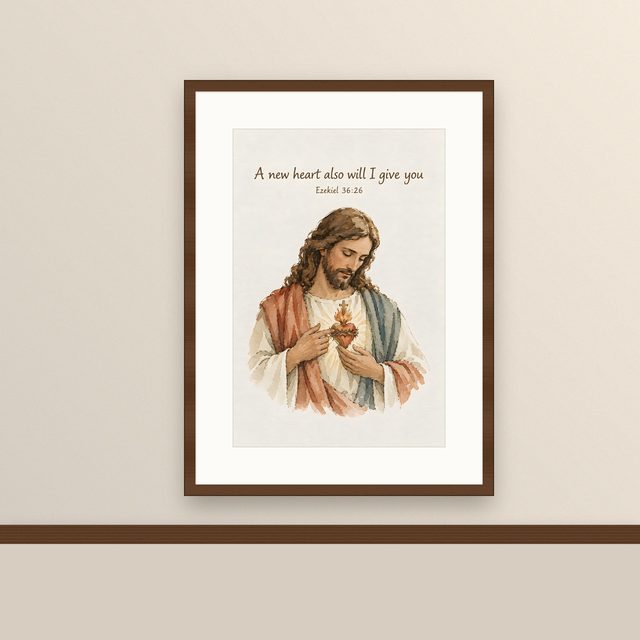
Ezekiel 36 · King James Version
26 A new heart also will I give you
A priest among the exiles
Ezekiel was a priest taken to Babylon in 597 BC, in the first wave of deportations from Jerusalem. He lived among the exiles by the river Chebar, and his early prophecies warned that the city would fall. In 586 BC it did: the Babylonians burned the temple and carried off many more people.
After that news reached him, Ezekiel's message turned toward hope. Chapters 33 to 48 are largely about restoration, and chapter 36 speaks first to the mountains of Israel, promising that the empty land will be farmed and filled again.
What does “a new heart” mean?
In Hebrew thought the heart is not mainly the seat of feelings. It is the center of the whole person: thinking, choosing, remembering, wanting. So a new heart means a new inner life, a different way of seeing and deciding.
The full verse sets two images side by side. God will put a new spirit within the people, take away the heart of stone and give a heart of flesh. Stone is cold, hard and unresponsive; flesh is alive and can feel. The next verse explains how: God will put his own Spirit within them, and they will walk in his ways.
Notice who acts. The verbs are all God's. Earlier, in chapter 18, Ezekiel urged the people to make themselves a new heart; here God promises to do what they could not do themselves. The motive, verse 22 says, is God's own name, not Israel's merit.
The verse and the Sacred Heart
Our print pairs the verse with the Sacred Heart of Jesus, a devotion especially loved in Catholic homes, where the image of Christ's heart stands for his human and divine love. Ezekiel's promise of a living heart given by God is a natural companion to it. Beyond Catholic practice, the verse is often chosen for adult baptisms, confirmations and fresh starts after a hard season.
The new covenant theme
Jeremiah 31, from the same period, promises a new covenant with the law written on hearts. Chapter 37 of Ezekiel follows with the valley of dry bones coming to life. In the New Testament, Paul speaks of letters written not on tables of stone but on fleshy tables of the heart (2 Corinthians 3), and Jesus tells Nicodemus that a person must be born again (John 3).