Bible verse wall art
Joshua 24: as for me and my house
Joshua 24 is an old leader's last public speech, and its most famous line is a decision rather than a command. It has become one of the best loved Bible verses for American homes.
Joshua 24 print
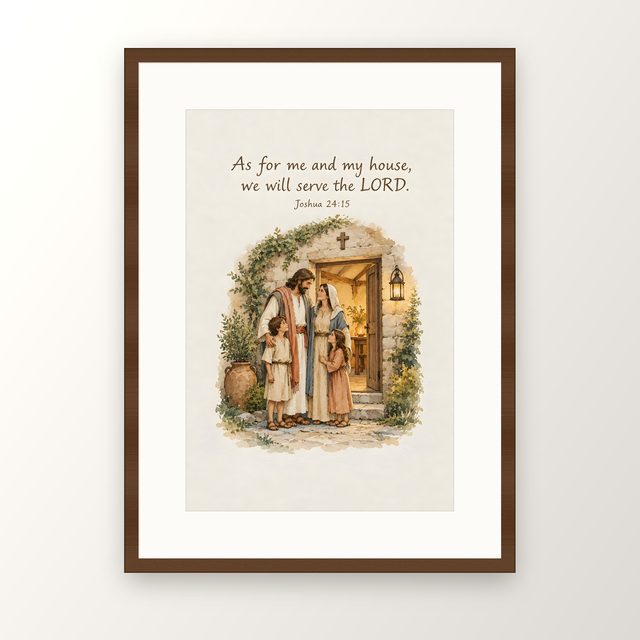
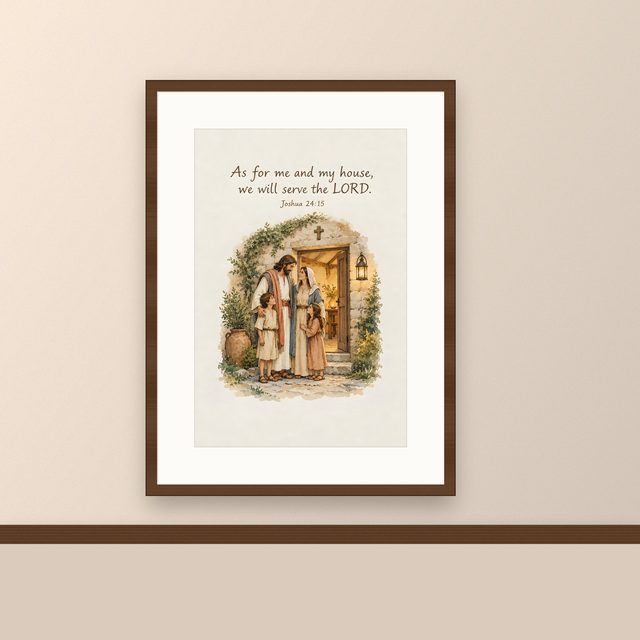
Joshua 24 · King James Version
15 As for me and my house, we will serve the LORD.
An assembly at Shechem
Joshua is now very old; the chapter ends with his death at the age of one hundred and ten. He gathers all the tribes at Shechem, a place already rich with memory: Abraham built an altar there when he first entered Canaan, and at the end of the chapter the bones of Joseph, carried up from Egypt, are buried there.
Before asking anything, Joshua retells the story. Speaking in God's name, he goes back to Terah, Abraham's father, who served other gods beyond the river, then through Isaac and Jacob, the slavery in Egypt, Moses and Aaron, the crossing of the Red Sea, the wilderness and the land they now live in. Everything they have, he reminds them, is a gift: cities they did not build and vineyards they did not plant.
What does Joshua 24:15 mean?
Only then does Joshua put the question. If serving the LORD seems evil to them, they must choose that day whom they will serve: the gods their ancestors served on the other side of the flood (the Euphrates, since “flood” in the King James means river), or the gods of the Amorites in whose land they now live. Then he states his own decision: As for me and my house, we will serve the LORD.
Two things stand out. First, faith here is a choice made in public and renewed, not a birthright assumed. Second, Joshua speaks for his household. In the ancient world a house meant the whole family unit, including children and servants, and he commits them to a shared direction. The people answer that they too will serve the LORD, and Joshua, perhaps surprisingly, warns them that it will not be easy. The covenant is written down and a great stone is set up under an oak as a witness.
Over the front door
Few verses are displayed in American homes as often as this one. It is lettered above entryways, on kitchen walls and on wedding signs, and it is a favorite housewarming gift for a young couple or a family moving into a new house. A Joshua 24:15 print says, quietly, what a home is meant to be about.
Choosing, again and again
Joshua's challenge echoes Moses in Deuteronomy 30, who set before Israel life and death and urged them to choose life. Centuries later Elijah puts a similar question on Mount Carmel: how long halt ye between two opinions? In the Gospel of John, when many turn away, Jesus asks the twelve whether they too will go, and Peter chooses to stay.