Bible verse wall art
Mark 4: peace, be still
Mark 4 starts with Jesus teaching from a boat and ends with Jesus asleep in one. The storm at the end of the chapter answers a question the parables leave hanging: who is this man?
Mark 4 print
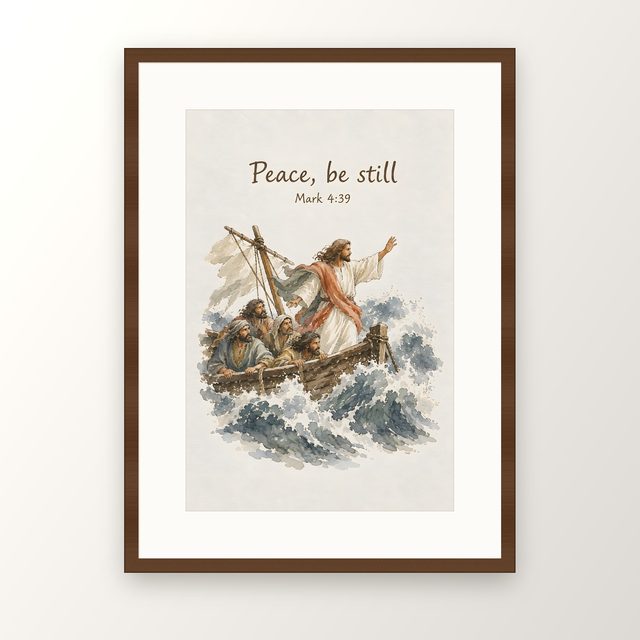
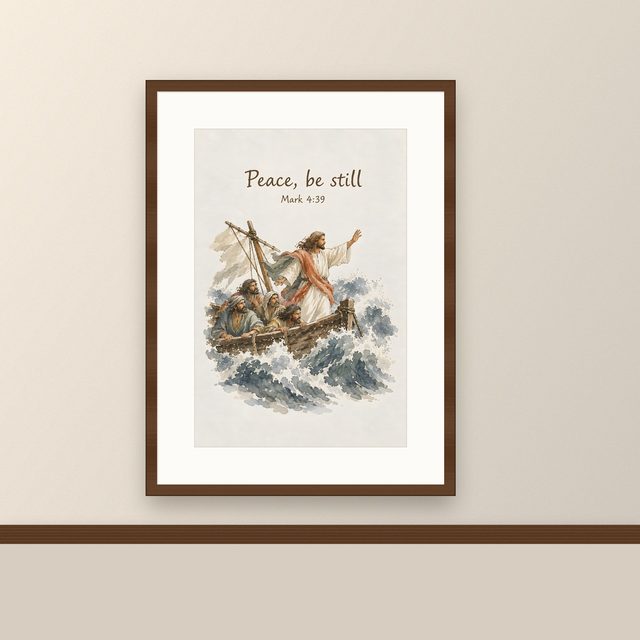
Mark 4 · King James Version
39 Peace, be still
A day of parables by the lake
Mark is the shortest of the four Gospels and, in the view of most scholars, the earliest, with an early tradition linking it to the preaching of Peter. In chapter 4 the crowd is so large that Jesus gets into a boat and teaches from the water. He tells the parable of the sower, whose seed falls on the path, on rocky ground, among thorns and on good soil; then short sayings about a lamp that is not hidden under a bushel, seed that grows while the farmer sleeps, and the mustard seed that becomes a great plant.
What does “Peace, be still” mean?
When evening comes, Jesus says, “Let us pass over unto the other side,” and the disciples take him across the Sea of Galilee. The lake lies about seven hundred feet below sea level, ringed by hills, and cool winds can rush down onto it and whip up sudden storms. Several of the disciples were fishermen who knew these waters, and still they are terrified: the waves beat into the boat until it is filling.
Jesus is in the stern, asleep on a pillow, a homely detail only Mark records. They wake him with a reproach: Master, carest thou not that we perish? He arises, rebukes the wind and says to the sea, Peace, be still. Mark uses the same verb Jesus had used to silence unclean spirits earlier in the Gospel, as if the storm were an enemy. The wind ceases, and there is a great calm.
Then Jesus asks why they are so fearful, and how is it that they have no faith. The disciples are now afraid in a new way, and ask each other the question the whole Gospel is built to answer: What manner of man is this, that even the wind and the sea obey him?
For anxious nights
The scene has spoken to sailors, to the sick and to the anxious for two thousand years, and it gave rise to the hymn “Master, the Tempest Is Raging.” A Peace, be still print often hangs in a bedroom, a hospital room or the office of a counselor. Matthew 8 and Luke 8 tell the same story in slightly different words.
The God who calms the sea
For readers who knew the Hebrew Scriptures, the answer to the disciples' question was already written. In the Old Testament, only God rules the raging sea. Psalm 107 describes sailors crying to the LORD in trouble: he maketh the storm a calm, so that the waves thereof are still. Mark lets the reader make the connection without saying it aloud.