Bible verse wall art
Micah 6: what the LORD requires
Micah 6 is staged like a trial, with the mountains called as witnesses. It ends with one of the most quoted sentences in the prophets, an answer so short it can be learned by heart in a minute.
Micah 6 print
Micah 6 · King James Version
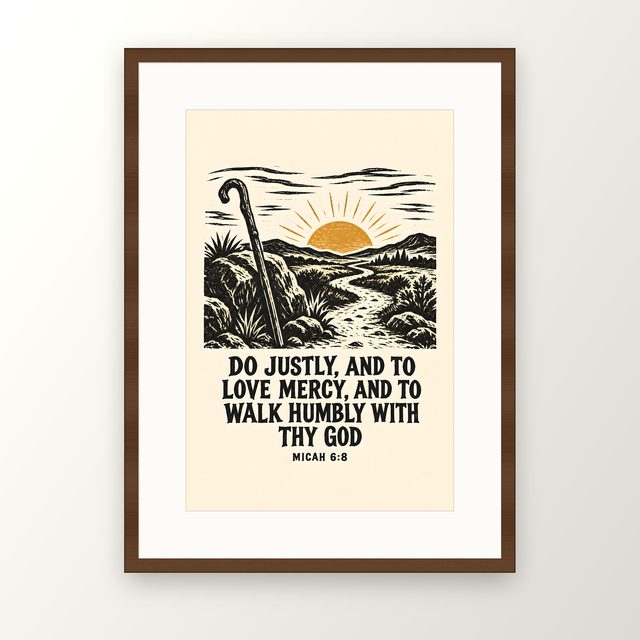
8 Do justly, and to love mercy, and to walk humbly with thy God
A prophet from the countryside
Micah came from Moresheth, a small town in the lowlands of Judah, and prophesied in the days of the kings Jotham, Ahaz and Hezekiah, in the eighth century before Christ. He was a contemporary of Isaiah. His book is remembered for its anger at powerful people who seize fields and houses, and also for the promise in chapter 5 that a ruler would come out of Bethlehem, a verse Matthew later quotes about the birth of Jesus.
God takes his people to court
Chapter 6 opens with a summons: the LORD has a controversy with his people, and the mountains and the foundations of the earth are to hear it. God does not begin with accusations but with a question, asking what he has done to weary them. He reminds them that he brought them out of Egypt and sent Moses, Aaron and Miriam before them, and that he turned the curse of Balaam into blessing.
The people answer as if bargaining. Should they come with burnt offerings and calves a year old? Would the LORD be pleased with thousands of rams or ten thousand rivers of oil? Should they even give their firstborn? Each offer is larger than the last, and each misses the point.
What does Micah 6:8 mean?
The prophet replies that the answer has already been shown. What does the LORD require, but to do justly, and to love mercy, and to walk humbly with thy God? The three phrases hold together. Justice is fairness done in practice, in weights, wages and courts, as the rest of the chapter makes clear with its condemnation of false balances. Mercy translates a rich Hebrew word for loyal, faithful kindness. And walking humbly describes a whole life lived in step with God, not a single act of worship.
The verse does not reject worship; it refuses worship used to cover injustice. That is why it has been painted on church walls, carved over courthouse doors and quoted in countless speeches. Our Humble Path print sets it in a linocut style scene of a road and a shepherd's staff, Christian wall art for an office, a classroom or a graduation gift.
The same message in other prophets
Hosea 6 says that God desired mercy, and not sacrifice, a line Jesus quotes twice in Matthew. Amos 5 calls for justice to roll down like waters. And in Matthew 23, Jesus tells the religious leaders they have neglected the weightier matters of the law: judgment, mercy and faith.