Bible verse wall art
Song of Solomon 6: I am my beloved's, and my beloved is mine
The Bible contains a whole book of love poetry, and this is its most famous line. Short enough to engrave inside a ring, it has been doing exactly that for centuries.
Song of Solomon 6 print
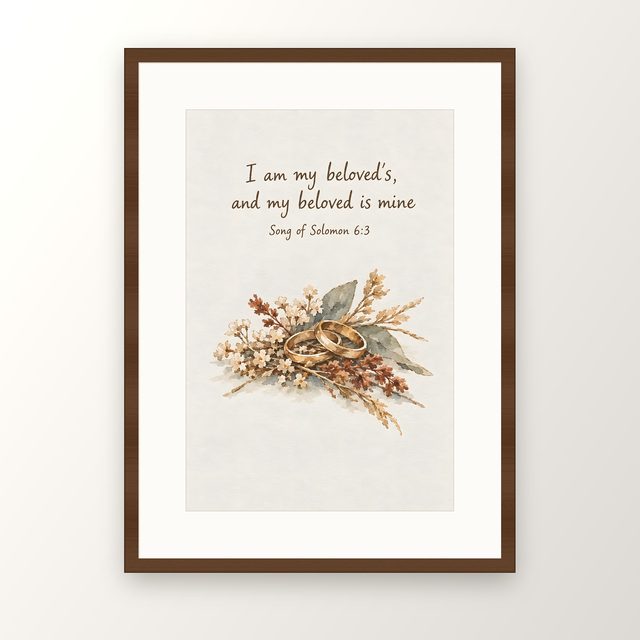
Song of Solomon 6 · King James Version
3 I am my beloved's, and my beloved is mine
A song of songs
The book opens with “The song of songs, which is Solomon's” (1:1), a Hebrew way of saying the finest of songs. It is a sequence of poems in which a young woman and her beloved speak to each other, with a chorus of the daughters of Jerusalem breaking in. God is hardly mentioned by name, and the language is frank, full of gardens, spices, vineyards, gazelles and springs.
Chapter 6 opens with a question from the chorus: “Whither is thy beloved gone, O thou fairest among women?” (6:1). She has been searching for him through the city at night in chapter 5, and now she answers with calm confidence: he has gone down to his garden.
What does Song of Solomon 6:3 mean?
The full verse reads: “I am my beloved's, and my beloved is mine: he feedeth among the lilies.” It is a statement of mutual belonging, with no one holding the upper hand. Each gives themselves and each receives the other.
The same words appear earlier in reverse order: “My beloved is mine, and I am his: he feedeth among the lilies” (2:16). Some readers see growth in the change. Early in the Song she speaks first of what she has; later, of whom she belongs to. Love that begins by possessing matures into love that gives itself away.
On wedding rings and at weddings
In Hebrew the phrase is Ani l'dodi v'dodi li, and it is one of the most common inscriptions on Jewish wedding rings. Its initial letters spell Elul, the month before the Jewish New Year, which tradition reads as a season of love between God and his people. Christian couples choose it too, for vows, invitations and anniversary gifts, often alongside another line of the book: “Many waters cannot quench love, neither can the floods drown it” (8:7).
Two ways of reading
Jewish tradition reads the Song as an allegory of God's love for Israel and recites it at Passover. Christian writers from Origen to Bernard of Clairvaux, who preached eighty-six sermons on it, read it as the love of Christ for the Church and for each soul. Many readers today also honor its plain meaning: the Bible treats married love between a man and a woman as a good gift worth a song.