Bible verse wall art
Zephaniah 3: the God who sings over his people
Zephaniah is one of the sternest books in the Bible, yet it closes with an image of God singing. Chapter 3 makes that turn, from warning to lullaby, in the space of a few verses.
Zephaniah 3 print
Zephaniah 3 · King James Version
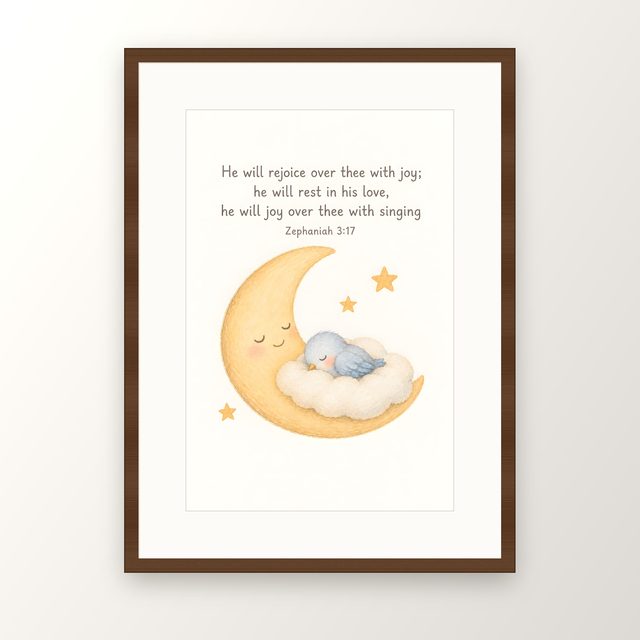
17 He will rejoice over thee with joy; he will rest in his love, he will joy over thee with singing
A prophet in the days of Josiah
The book's first verse places Zephaniah in the reign of Josiah king of Judah, in the seventh century before Christ, and traces his family back four generations to a man named Hizkiah, possibly King Hezekiah. His main theme is the day of the LORD, a day of wrath and darkness. The medieval hymn Dies irae, the day of wrath, takes its opening words from the Latin of his first chapter.
From woe to song
Chapter 3 begins with Jerusalem itself under judgment: woe to her that is filthy and polluted, to the oppressing city. Her princes are like roaring lions, her judges like evening wolves, her prophets and priests unfaithful. She would not listen or receive correction.
Then the tone changes. God promises to give the peoples a pure language so that all may call on his name. He will leave in the city an afflicted and poor people who trust in him, a remnant who will not do iniquity nor speak lies. And the prophet calls out: Sing, O daughter of Zion; shout, O Israel; be glad and rejoice with all the heart.
What does Zephaniah 3:17 mean?
Verse 17 explains why the city can sing: The LORD thy God in the midst of thee is mighty; he will save, he will rejoice over thee with joy; he will rest in his love, he will joy over thee with singing. The people are told to sing in verse 14, and here God sings too. It is one of the few places in Scripture where God himself is pictured singing.
The middle phrase is hard to translate, and modern versions render it in quite different ways. The King James words suggest a love so settled it can be quiet, the stillness of a parent watching a sleeping child. The last phrase is anything but quiet: the same God rejoices out loud.
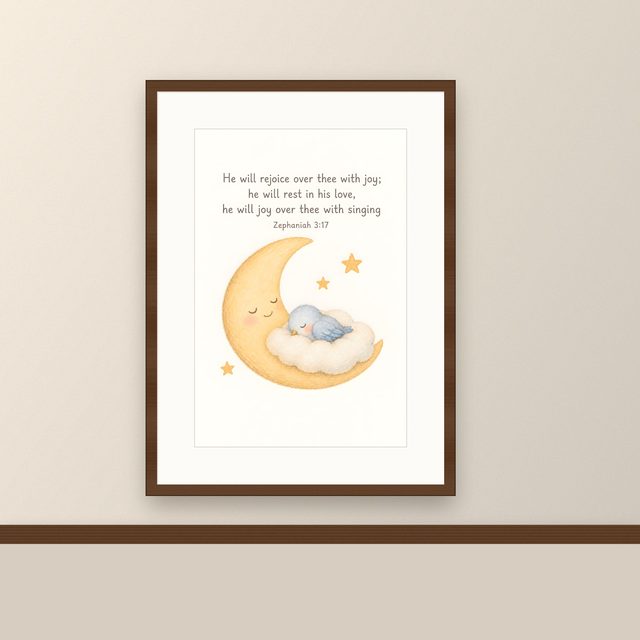
Read that way, the verse fits a nursery naturally. Our Moon and Little Bird print pictures it as a small blue bird asleep on a cloud beside a smiling crescent moon, soft Christian wall art for a baby's room, a baby shower or a baptism gift.
The same joy in Isaiah
Isaiah 62 uses a similar picture: as the bridegroom rejoices over the bride, so shall God rejoice over his people. Both prophets imagine God not as a reluctant judge who finally relents, but as someone who delights in the people he has saved.