Bible verse wall art
1 Samuel 1: Hannah prays for a son
Before there were kings in Israel, there was a woman crying in the house of the LORD because she had no child. Her prayer, and the son who answered it, open one of the great books of the Old Testament.
1 Samuel 1 prints
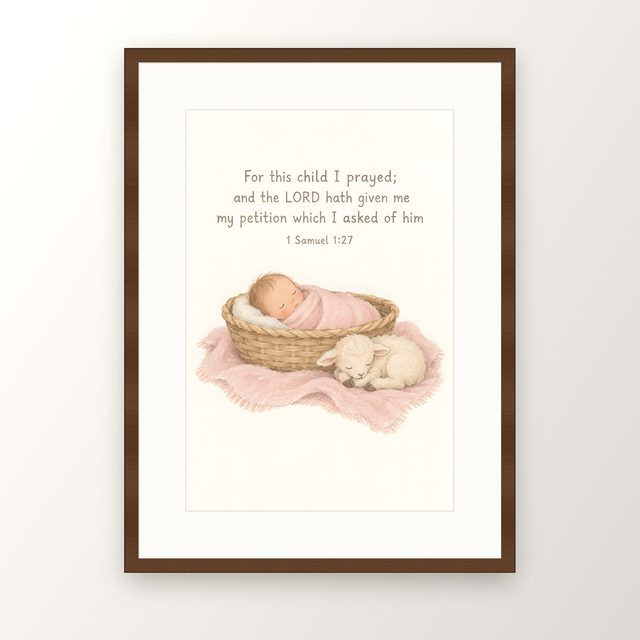
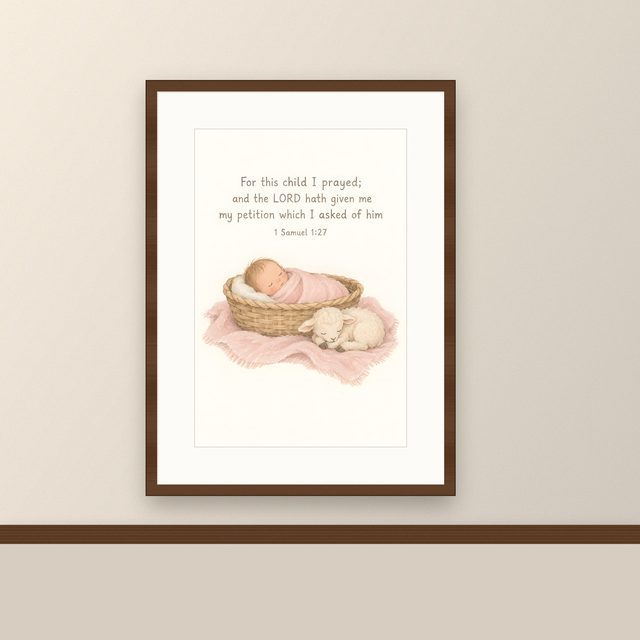
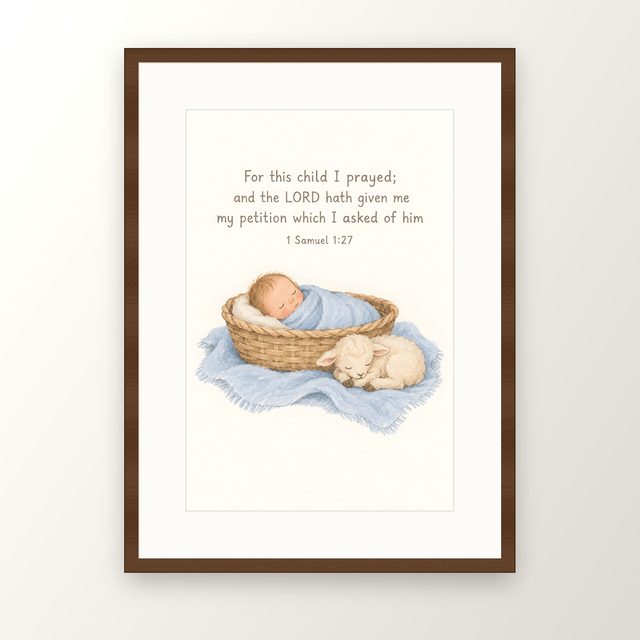
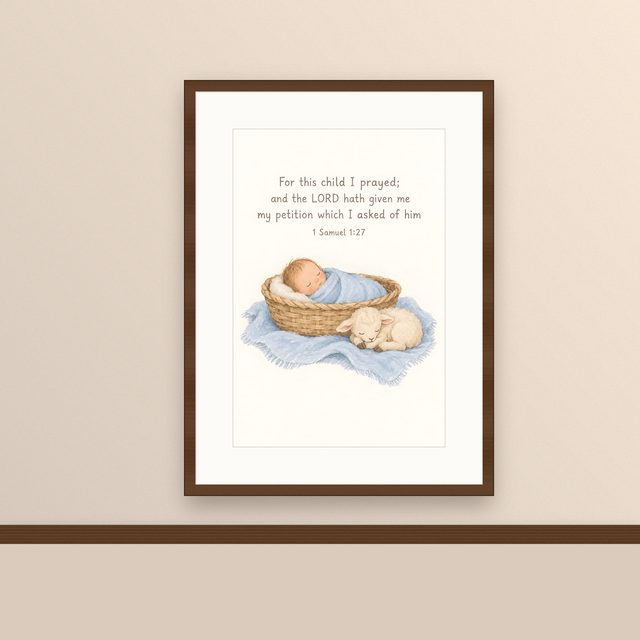
1 Samuel 1 · King James Version
27 For this child I prayed; and the LORD hath given me my petition which I asked of him
A family trip to Shiloh
Elkanah, a man from the hill country of Ephraim, has two wives. Peninnah has children; Hannah has none. Every year the family goes up to Shiloh, where the tabernacle stood, to worship and offer sacrifice, and every year Peninnah provokes Hannah until she weeps and cannot eat. Elkanah loves her and gives her a double portion, and asks, a little helplessly, whether he is not better to her than ten sons.
One year Hannah slips away to pray. She speaks in her heart, her lips moving but no sound coming out, and the old priest Eli assumes she is drunk. She explains that she is a woman of a sorrowful spirit who has been pouring out her soul before the LORD. Eli sends her away in peace and asks that God grant her request.
What does “For this child I prayed” mean?
Hannah had made a vow: if God gave her a son, she would give him back to the LORD all the days of his life, and no razor would touch his head. A son is born, and she names him Samuel, explaining in verse 20 that she asked him of the LORD. She keeps him at home until he is weaned, then brings him to Shiloh and presents him to Eli.
Verse 27 is what she says at that moment, the words on our print: “For this child I prayed; and the LORD hath given me my petition which I asked of him.” It is gratitude, but it is also a handing over. In the next verse she says she has lent him to the LORD for as long as he lives. The boy she longed for becomes the prophet who anoints Israel's first two kings.
A nursery print in pink or blue
Few verses fit a new baby as closely, especially after a long wait, infertility, loss or adoption. We offer the same scene in two colorways, a sleeping infant in a basket with a small lamb, on a pink blanket or a blue one. As Christian wall art for a nursery it works equally well as a baby shower, dedication or baptism gift, and parents often hang it above the crib or changing table.
Hannah's echo in the Gospels
Chapter 2 opens with Hannah's song of praise: God lifts the poor from the dust and brings down the proud. Readers have long noticed how closely Mary's song in Luke 1, the Magnificat, follows the same themes. Both women see in one child the sign that God overturns the order of the world. Other long-awaited births in Scripture, Isaac for Sarah and John the Baptist for Elizabeth, carry the same note of prayer answered after years of waiting.