Bible verse wall art
1 Samuel 17: David, Goliath, and “the battle is the LORD's”
Everyone knows the ending: a shepherd boy, a sling, a fallen giant. Less remembered is the sentence David shouts before he throws the stone, and it is the key to the whole chapter.
1 Samuel 17 print
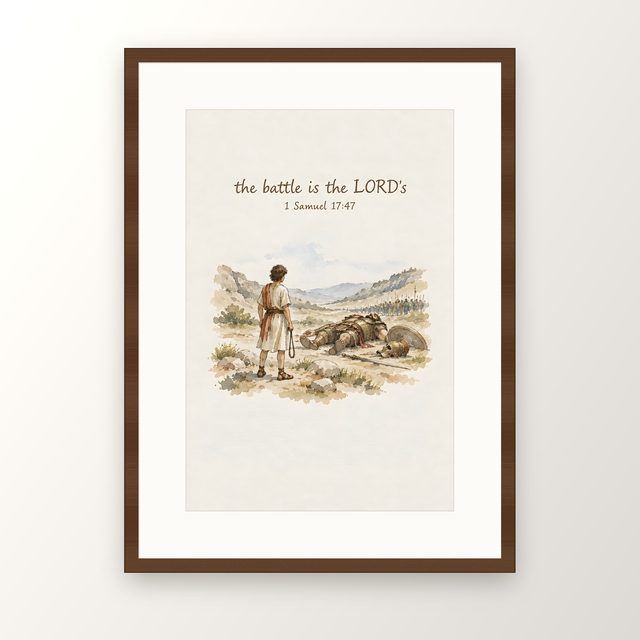
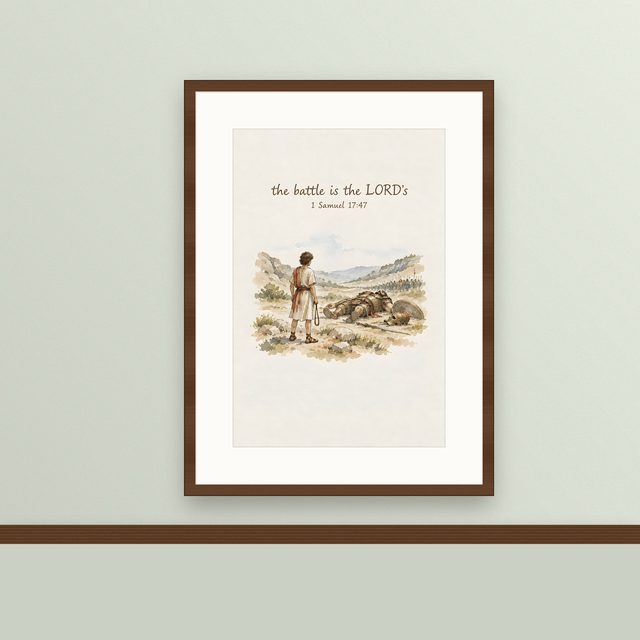
1 Samuel 17 · King James Version
47 the battle is the LORD's
The standoff in the valley of Elah
The Philistines, Israel's rivals on the coastal plain, have camped on one hillside and King Saul's army on the other, with the valley of Elah between them. That valley lies in the foothills southwest of Bethlehem and can still be visited. For forty days a champion from Gath named Goliath walks out each morning and evening and challenges Israel to send one man to fight him.
The text describes him in detail: a height of six cubits and a span (well over nine feet in the traditional Hebrew text, closer to seven in some ancient Greek and Dead Sea manuscripts), a bronze helmet, a coat of mail, and a spear shaft like a weaver's beam. Saul, himself described as head and shoulders taller than anyone, does nothing.
What does “the battle is the LORD's” mean?
David arrives only because his father sends him with bread and cheese for his older brothers. He hears the challenge, is offended that anyone would defy “the armies of the living God”, and volunteers. He refuses Saul's armor because he has not tested it, and goes down with his staff, five smooth stones and a sling, the weapon of a shepherd who had already faced lions and bears.
In verses 45 to 47 he answers Goliath's insults. The giant comes with sword and spear; David comes in the name of the LORD of hosts. Then the line on our poster: God does not save with sword and spear, for the battle is the LORD's. David is not boasting about his aim. He is saying that the outcome belongs to God, so that everyone watching will know there is a God in Israel.
That is why the story is about trust more than bravery. The underdog wins, but the point is who stands behind the underdog.
Why the story endures
It is often among the first Bible stories children learn, and a David and Goliath print suits a boy's room, a Sunday school wall or a gift for someone facing a battle that looks unwinnable: an illness, a court case, a first job. The phrase “David and Goliath” has also passed into everyday English for any contest between the small and the mighty.
The same words elsewhere in the Bible
Centuries later, in 2 Chronicles 20, a prophet tells King Jehoshaphat almost the same thing before a battle: the fight is not yours but God's. And Psalm 20 contrasts those who trust in chariots and horses with those who remember the name of the LORD, the same contrast David draws in the valley.