Bible verse wall art
Exodus 20: the Ten Commandments
Carved in stone, argued over in courthouses, memorized in Sunday school: few texts have shaped Western law and morality like Exodus 20. It begins not with a rule but with a reminder of rescue.
Exodus 20 print
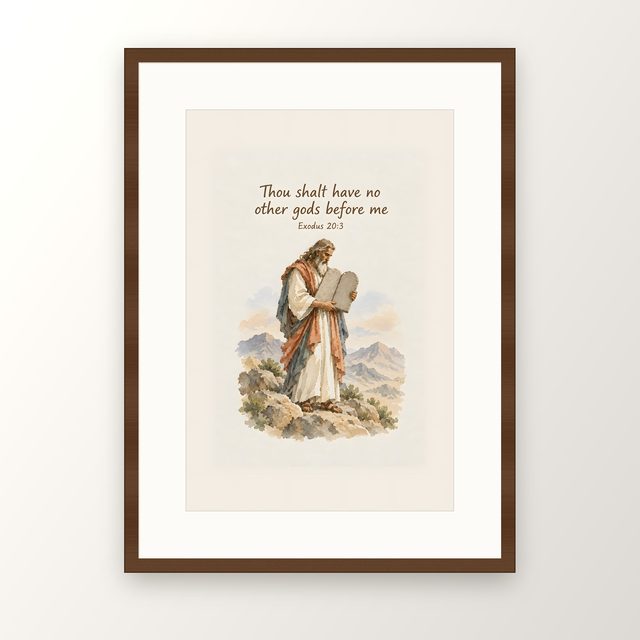
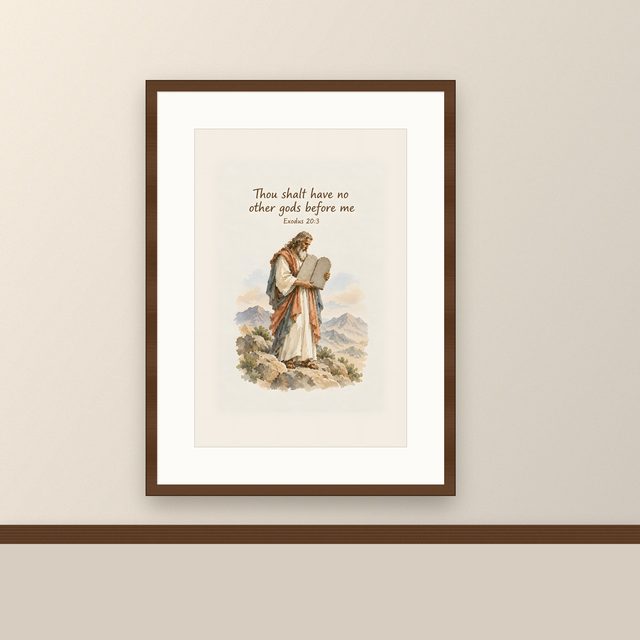
Exodus 20 · King James Version
3 Thou shalt have no other gods before me
Thunder at Mount Sinai
Three months after leaving Egypt, the Israelites camp at the foot of Mount Sinai. Chapter 19 describes thunder, lightning, a thick cloud, smoke and the blast of a trumpet growing louder, and the people are told not to touch the mountain. Chapter 20 is what God speaks there. The Hebrew tradition calls these the “ten words”, which is where the Greek name Decalogue comes from.
A second version appears in Deuteronomy 5, with small differences, most famously in the reason given for the Sabbath: remembering creation in Exodus, remembering slavery in Deuteronomy.
What does “no other gods before me” mean?
The commandments open with verse 2, which is easy to skip: I am the LORD thy God, who brought you out of Egypt, out of the house of bondage. Obedience is a response to freedom already given, not a way of earning it. Then comes verse 3, the line on our print.
“Before me” can also be translated “besides me” or “in my presence”. In a world where every nation had many gods, and where people hedged their bets by honoring several, Israel was to give its loyalty to one God alone. It is a statement about allegiance before it is a statement about theology, and the image of a marriage, used later by the prophets, fits it well.
The rest of the list follows from that first loyalty. Roughly, the first commands concern God (no idols, no misuse of his name, keep the Sabbath), and the rest concern neighbors: honor parents, and do not murder, commit adultery, steal, lie in court, or covet.
Why the numbering differs
The text has more than ten verbs, so traditions group them differently. In Jewish tradition verse 2 is the first word. Catholics and Lutherans, following Augustine, join the ban on other gods and on images into one commandment and divide coveting into two. Orthodox and most Protestant churches count the images command separately. No group is dropping anything; they are grouping the same text.
Families hang the commandments in a hallway or a child's room, and churches often display them near the entrance or in a catechism classroom.
The commandments in the New Testament
When asked for the greatest commandment, Jesus answered with Deuteronomy 6 and Leviticus 19: love God with all your heart, and your neighbor as yourself (Mark 12). Those two lines neatly summarize the two halves of Exodus 20. In the Sermon on the Mount (Matthew 5) he takes the commands against murder and adultery and applies them to anger and desire.