Bible verse wall art
Exodus 3: the burning bush and “I AM THAT I AM”
A shepherd sees a bush that burns without burning up, walks closer, and hears his name. By the end of the chapter he has been given a mission and the most mysterious name for God in the Bible.
Exodus 3 print
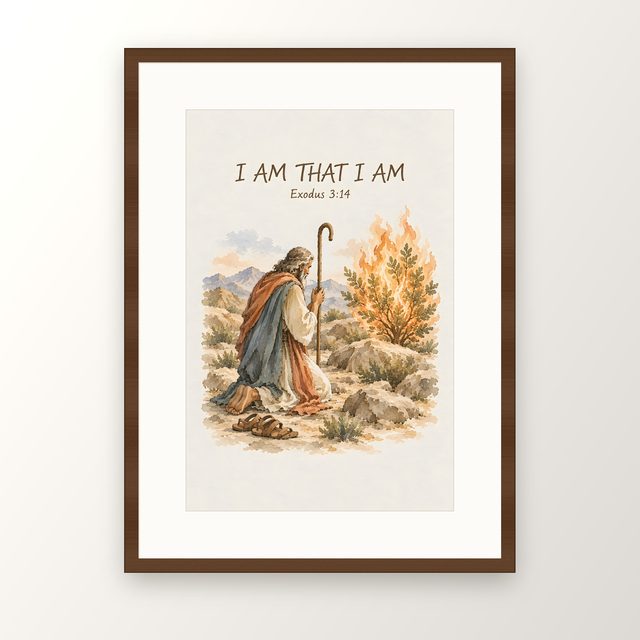
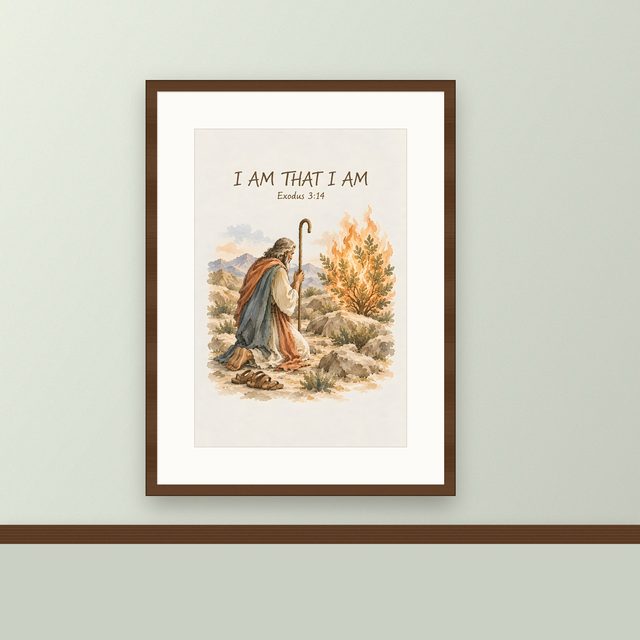
Exodus 3 · King James Version
14 I AM THAT I AM
Moses in the desert
Moses was born a Hebrew in Egypt, raised in Pharaoh's household, and forced to flee after killing an Egyptian who was beating a Hebrew slave. He settled in Midian, married Zipporah, and spent years keeping the flocks of his father-in-law Jethro. Chapter 3 finds him leading those sheep to the far side of the wilderness, to Horeb, called the mountain of God.
There he notices a bush on fire that is not consumed. When he turns aside to look, God calls to him from the bush, tells him to take off his sandals because the ground is holy, and says he has seen the misery of his people in Egypt and heard their cry.
What does “I AM THAT I AM” mean?
Moses raises objections, and the second is practical: when I tell the Israelites the God of your fathers sent me, they will ask his name. What shall I say? God answers in verse 14 with the words on our print, and adds, tell them I AM has sent me.
The Hebrew is ehyeh asher ehyeh, built on the verb “to be”. It can be translated “I am who I am” or “I will be what I will be”, and both senses are probably intended. On one hand it is a refusal to be pinned down: God is not a local spirit to be named and managed. On the other it is a promise of presence, since a few verses earlier God has said, I will be with thee, using the same verb.
The next verse gives the personal name, four Hebrew letters usually written YHWH. Out of reverence, Jewish readers do not pronounce it and say Adonai, “Lord”, instead. That custom is why the King James prints LORD in small capitals wherever the divine name stands in the Hebrew.
Holy ground in daily life
The burning bush has become a symbol of calling and vocation. Several Reformed and Presbyterian churches use it as their emblem, the Church of Scotland with a Latin motto meaning “yet it was not consumed”. A print of verse 14 suits a pastor's study, an ordination gift, or anyone who has felt called to something larger than themselves.
“I am” in the Gospel of John
In the fourth Gospel, Jesus repeatedly describes himself with “I am” sayings, naming himself the light of the world, the door, the true vine, the good shepherd. Most dramatically, in John 8:58 he says, “Before Abraham was, I am”, and his listeners take up stones, understanding it as a claim to share the divine name.