Bible verse wall art
Genesis 1: “So God created man in his own image”
The Bible's first chapter moves in a steady rhythm of days, and on the sixth it slows down. For the first time, the text breaks into poetry to describe what God has made.
Genesis 1 print
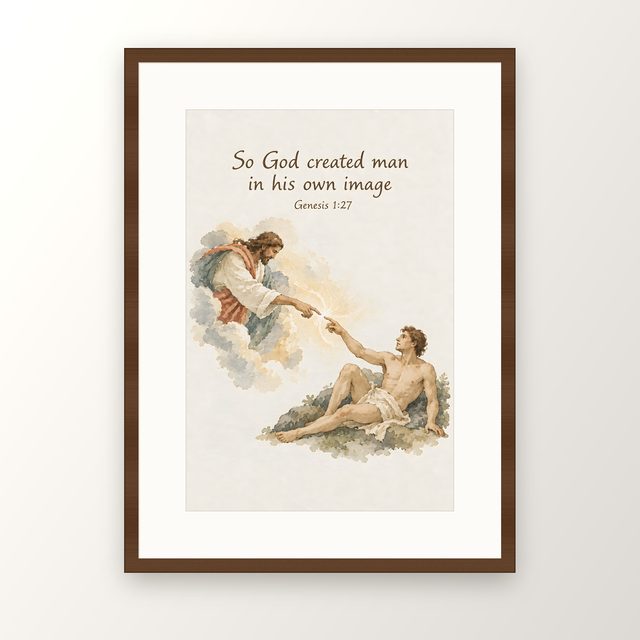
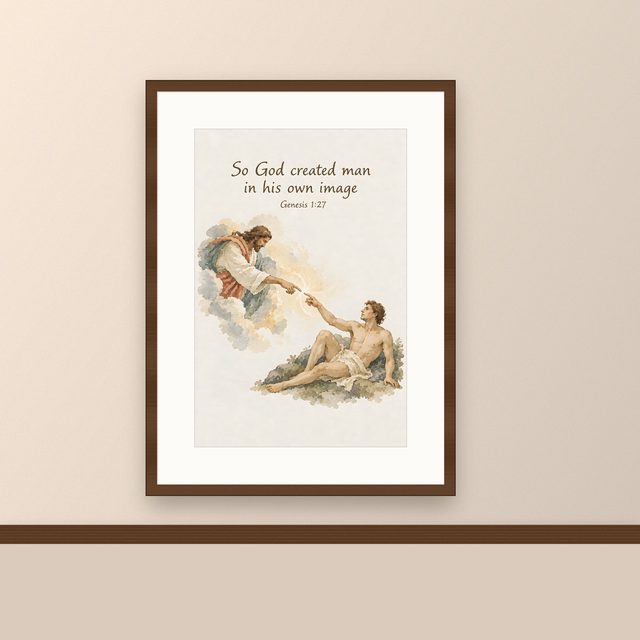
Genesis 1 · King James Version
27 So God created man in his own image
Six days and a pattern
Genesis 1 describes creation in seven days, each marked by the refrain “and the evening and the morning were”. The first three days separate: light from darkness, waters above from waters below, sea from dry land. The next three fill what was separated: sun, moon and the lights of the night sky; birds and fish; land animals. The seventh day is rest.
Christians read this chapter in different ways, as a literal week, as a literary framework, or as an ancient text answering the questions of its own time. Almost all agree on its main claims: that one God made everything, that what he made is good, and that human beings have a special place within it.
What does it mean to be made in God's image?
On the sixth day God says, Let us make man in our image, after our likeness, and gives humans dominion over the other creatures. Verse 27 then repeats “created” three times in a short poem: God created man in his own image, in the image of God he created him, male and female he created them. The word “man” here is the Hebrew adam, meaning humankind, and the verse makes clear that both women and men bear the image.
In the ancient Near East, kings set up statues of themselves in distant provinces to show whose land it was, and some kings were themselves called the image of a god. Genesis gives that honor to every human being. People are God's living representatives on earth, meant to care for creation the way a good king cares for his realm.
Theologians have linked the image to reason, to moral sense, to relationship, or to that role of stewardship. Whatever it includes, it grounds the belief that every person has dignity that does not depend on age, ability or usefulness.
Michelangelo and a nursery wall
The verse stands behind Michelangelo's Creation of Adam on the Sistine Chapel ceiling, where God's finger almost touches Adam's. Parents welcoming a newborn often pick Genesis 1:27 for the baby's room or a christening, since it says plainly whose likeness that little face carries.
The image restored
Genesis 9 forbids murder precisely because humans are made in God's image, and James 3 applies it to speech: we should not curse people made in God's likeness. The New Testament calls Christ the image of the invisible God (Colossians 1:15), and Paul speaks of believers being renewed in that image.