Bible verse wall art
Isaiah 53: “He is despised and rejected of men”
Written centuries before the crucifixion, this chapter describes an innocent servant who suffers for others. Since the first century, Christians have read it as a portrait of the Passion.
Isaiah 53 print
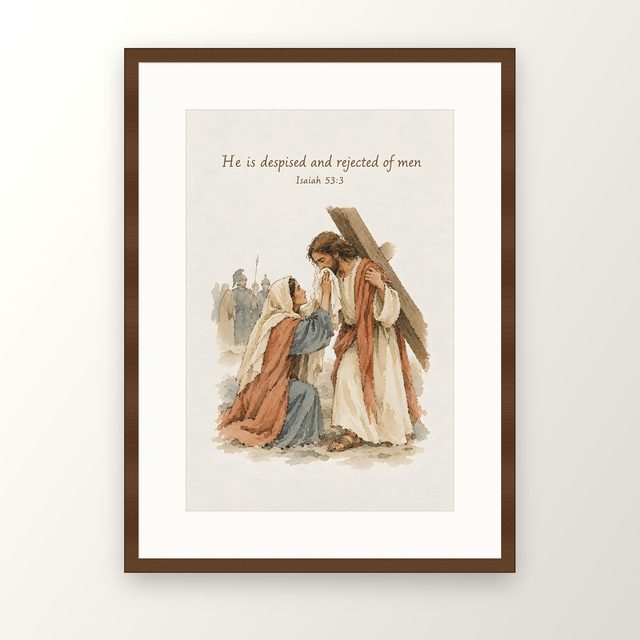
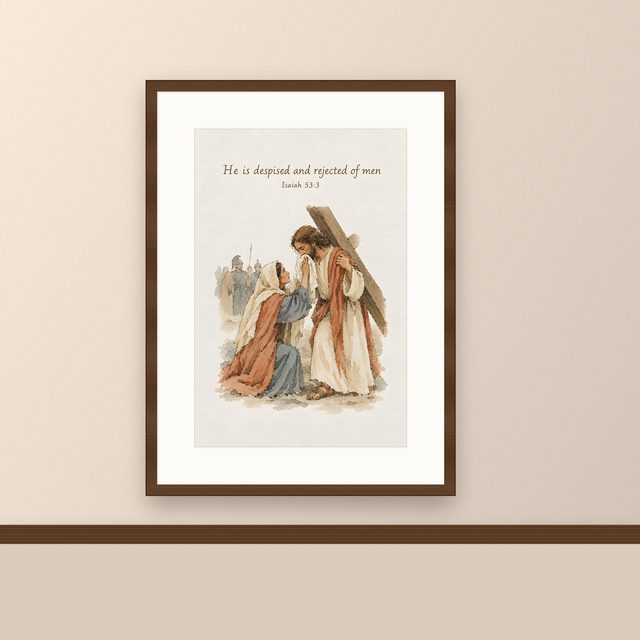
Isaiah 53 · King James Version
3 He is despised and rejected of men
The fourth servant song
The second half of Isaiah contains four passages that scholars call the servant songs, in chapters 42, 49, 50 and the long poem that runs from 52:13 to the end of chapter 53. Each describes a mysterious figure, the servant of the LORD, who brings justice to the nations and suffers in the process.
The fourth song begins with the servant's final exaltation and then goes back to tell how he got there. Much of it is spoken by a group of onlookers, a “we” who once misjudged the servant and now understand what they saw.
What does Isaiah 53:3 mean?
Verse 2 describes the servant as a tender plant growing out of dry ground, with no beauty that would make anyone want to look at him. Verse 3, the line on our print, goes further: he is despised and rejected, a man of sorrows, acquainted with grief, someone people hid their faces from. The rejection is total, social as well as personal.
Then comes the turn that has made the chapter so important. Verses 4 to 6 reveal that the suffering was not what it seemed. He carried our griefs; he was wounded for our transgressions; with his stripes we are healed. All we like sheep have gone astray, and the LORD laid on him the iniquity of us all. The onlookers realize the servant was bearing their punishment, not his own.
Jewish interpretation has most often understood the servant as the people of Israel, suffering among the nations, or as a righteous individual. From the earliest days, Christians have read the passage as a portrait of Jesus. Both readings take the text seriously; this page describes the Christian one because the poster belongs to that tradition.
Holy Week and the Stations of the Cross
Isaiah 52:13 to 53:12 is the Old Testament reading for Good Friday in the Catholic lectionary and in many Protestant ones. Our print pairs verse 3 with the Stations of the Cross, the devotion in which believers pause at fourteen scenes of Christ's passion, often on Lenten Fridays. Handel set several of these verses in Messiah, including an aria on this line.
Isaiah 53 in the New Testament
In Acts 8, an Ethiopian official reading this chapter in his chariot asks Philip who the prophet means, and Philip tells him about Jesus. Matthew 8 quotes verse 4, and 1 Peter 2 draws on verses 5 and 6, calling Christ the shepherd of souls who went astray.