Bible verse wall art
Revelation 19: King of kings, and Lord of lords
Handel set part of this chapter to music, and audiences have risen to their feet for it ever since. Revelation 19 is where the book's long conflict turns to victory.
Revelation 19 print
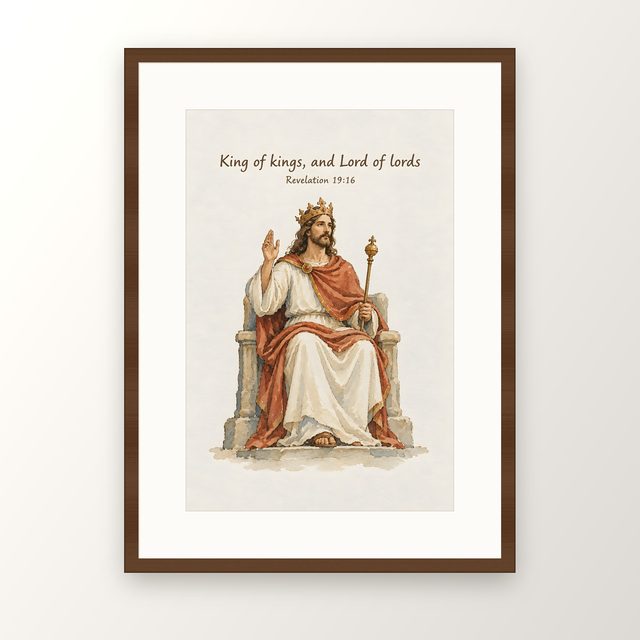
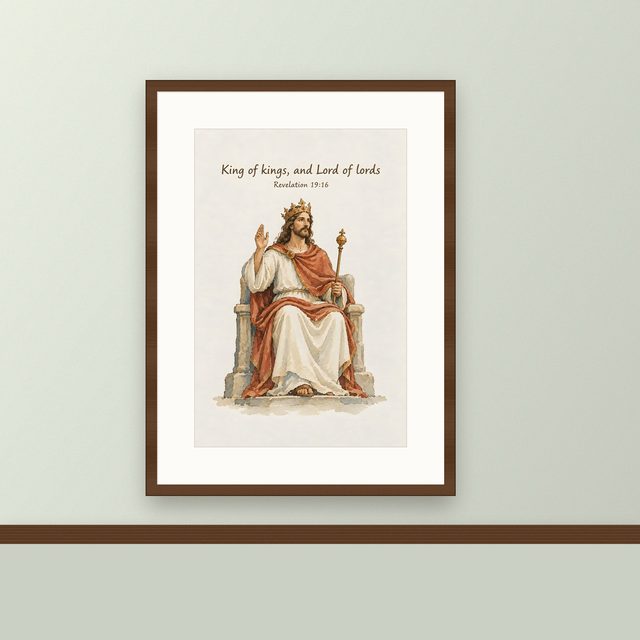
Revelation 19 · King James Version
16 King of kings, and Lord of lords
Hallelujah in heaven
In the chapters before, John has watched the fall of Babylon, the book's name for a proud and violent world power. Chapter 19 opens with the response of heaven: a great multitude crying “Alleluia”. The word appears four times in these first verses and nowhere else in the New Testament. Verse 6 gives the line Handel used: “Alleluia: for the Lord God omnipotent reigneth.”
Then comes an announcement of the marriage supper of the Lamb, with the bride clothed in fine linen, “the righteousness of saints” (19:8).
The rider on the white horse
At verse 11 heaven opens and a rider appears, called Faithful and True. His eyes are like a flame of fire, he wears many crowns, his clothing is dipped in blood, and his name is The Word of God. The armies of heaven follow him, dressed in white linen. A sharp sword comes from his mouth: he wins, in other words, by what he says.
What does Revelation 19:16 mean?
“And he hath on his vesture and on his thigh a name written, KING OF KINGS, AND LORD OF LORDS.” A name written on the robe where it falls across the thigh would be visible to anyone as the rider went by. The King James prints it in capitals, as it prints the inscription on the cross.
“King of kings” was a real royal title in the ancient world. The Bible gives it to Nebuchadnezzar of Babylon (Daniel 2:37) and Artaxerxes of Persia (Ezra 7:12). Revelation takes the proudest title of the empires and gives it to Christ. The same phrase appears in 1 Timothy 6:15, and in reversed order in Revelation 17:14, where the Lamb overcomes the kings of the earth.
Christ the King
In 1925 Pope Pius XI established the feast of Christ the King, now kept by Catholics on the last Sunday before Advent, and many Lutheran, Anglican and Methodist churches mark the same Sunday. The title also runs through the “Hallelujah” chorus of Messiah, sung every Christmas and Easter. A print of this verse belongs in a church office, a study, or a home that wants its walls to say who reigns.