Bible verse wall art
Revelation 3: Jesus knocks at the door
Revelation 3 ends the seven letters to the churches of Asia Minor. The last one is the sharpest, written to a comfortable church, and it closes with the gentlest image in the whole book.
Revelation 3 print
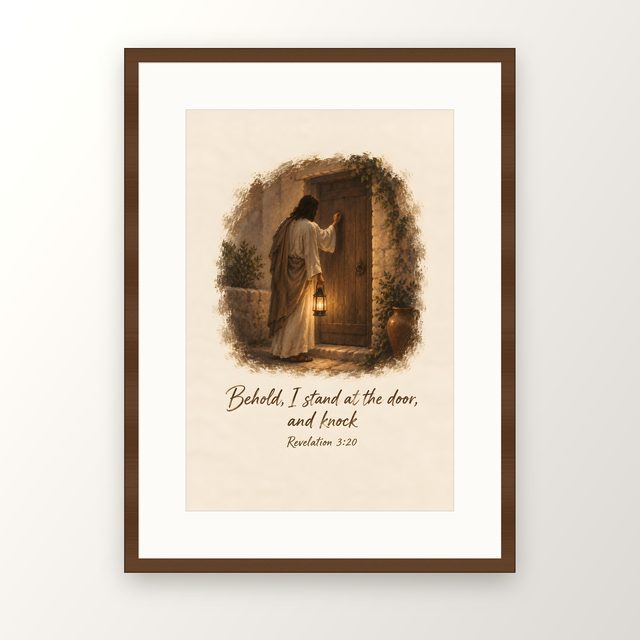
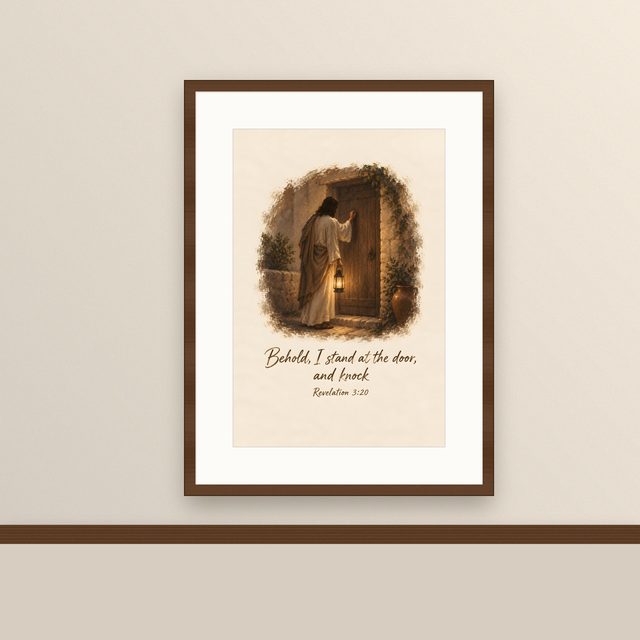
Revelation 3 · King James Version
20 Behold, I stand at the door, and knock
Three letters
Chapters 2 and 3 of Revelation contain short messages from the risen Christ to seven churches in the Roman province of Asia, in what is now western Turkey. Each letter praises, rebukes or encourages, and each ends with a promise to the one who overcomes.
Chapter 3 holds the last three. Sardis has a name that it lives, but is dead, and is told to wake up and strengthen what remains. Philadelphia has little strength but has kept the word, and Christ sets before it an open door that no one can shut. Laodicea receives no praise at all.
Neither cold nor hot
Laodicea was a prosperous city in the Lycus valley, known for banking, textiles and a medical school. The church there says, I am rich, and increased with goods, and have need of nothing. Christ replies that it is wretched, poor, blind and naked, and neither cold nor hot but lukewarm. Many commentators link the image to the city's water supply, brought in from a distance, compared with the hot springs of nearby Hierapolis and the cold water of Colossae.
He counsels the church to buy from him gold tried in the fire, white clothing and salve for its eyes, the very things the city thought it had in abundance. Then, in verse 19: as many as I love, I rebuke and chasten.
What does “I stand at the door, and knock” mean?
Verse 20 follows: Behold, I stand at the door, and knock: if any man hear my voice, and open the door, I will come in to him, and will sup with him, and he with me. Surprisingly, Christ stands outside a church that bears his name. He does not break the door down. He knocks and speaks, and waits for someone inside to open.
The promise that follows is a shared meal, a sign of friendship and welcome in the ancient world. Though the letter was addressed to a congregation, the words any man make it personal, and evangelists have long used this verse to invite individuals to faith.
The Light of the World
The best known image of this verse is William Holman Hunt's painting The Light of the World, completed in the 1850s, now in Keble College, Oxford, with a later version in St Paul's Cathedral in London. It shows Christ with a lantern before an overgrown door that has no handle on the outside. Our Jesus Knocking print belongs to that tradition, Christian wall art for an entryway, the space beside a front door, or the room of someone you hope will open.