Stations of the Cross, John 19:17 Wall Art
John 19:17 · King James Version Free US shipping
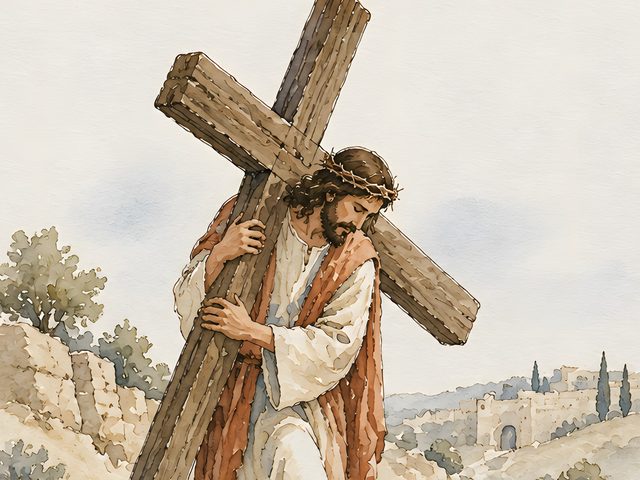
“And he bearing his cross went forth”
John 19:17
Build a gallery wall: save 25% on 3 prints or more, applied in your cart.
- Free US shipping
- Printed in the USA
- 30-day returns
- King James text, checked
- 7
- words of Scripture
- 2
- prints from John 19
- $29
- smallest print
- 2–5
- days to dispatch
The print
A giclée print on thick archival matte paper of at least 200gsm. The verse is set into the painting in the King James Version, with a blank paper margin that makes framing easy. Sold without a frame.
Shipping
Printed to order and shipped within 2 to 5 business days, from a print studio in the United States. Shipping is free on every order.
Returns
Returns accepted within 30 days of delivery.
Digital download
Seven high-resolution files covering every common frame ratio, 4096 × 6144 px, good for printing up to A1. Nothing is shipped.
About this print
Stations of the Cross, John 19:17
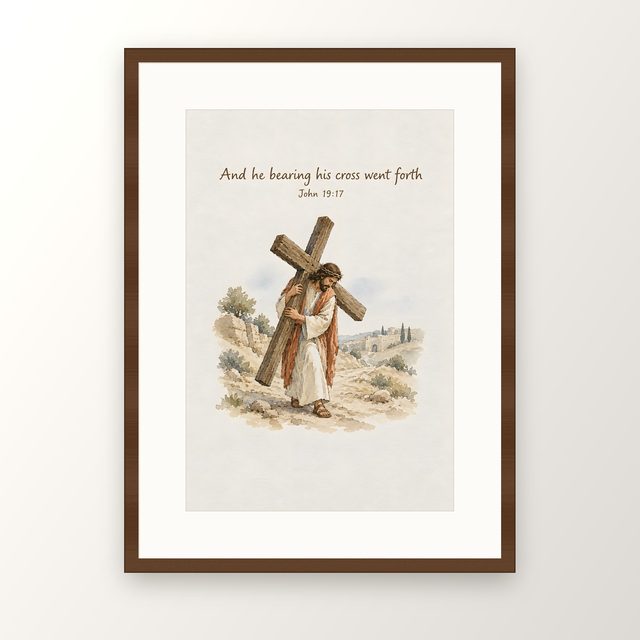
Bent under a rough beam, crowned with thorns, Jesus walks out of the city along a dusty track, painted under John's plain account of the road to Golgotha.
On the road out of the city
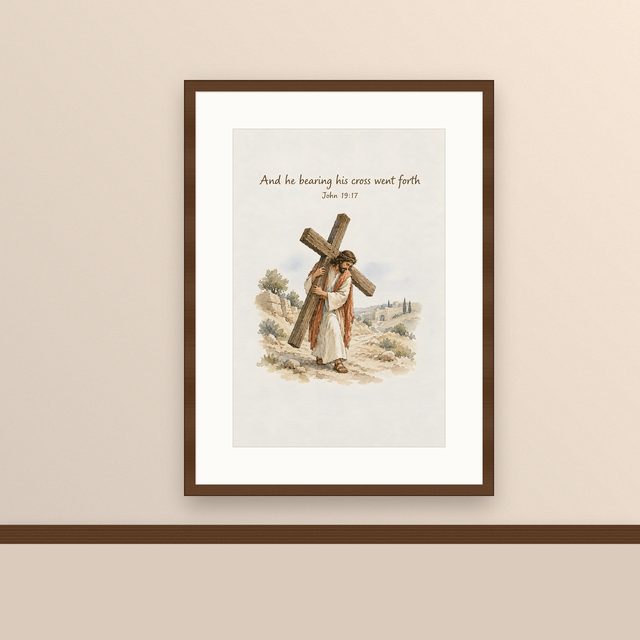
The cross is heavy and unfinished, two squared timbers with the grain still showing, and Jesus carries it on his right shoulder with both arms wrapped around the upright. He wears a crown of thorns, a long cream tunic and a tattered rust-colored mantle, and his eyes are lowered to the path. His sandaled feet are mid-stride on pale, stony ground.
Behind him the landscape is dry and sun-bleached: scrubby bushes, a crumbling rock face on the left, and on the right a stretch of city wall with an arched gate and a few cypresses. It is the moment just after he has passed through. A single line of script crowns the page: “And he bearing his cross went forth”.
What John 19:17 tells us
In the King James text the sentence goes on: “into a place called the place of a skull, which is called in the Hebrew Golgotha”. Calvary, the more familiar English name, comes from the Latin word for skull. Executions were held outside the walls, which is why the painting shows the gate behind him.
John's wording is deliberate. Matthew, Mark and Luke all mention Simon of Cyrene, a passer-by forced to carry the cross. John does not; he stresses that Jesus bore it himself, going out willingly. The two accounts are usually read together: Jesus set out carrying the beam, and Simon was pressed into service along the way.
The phrase “went forth” quietly echoes older stories, such as Isaac carrying the wood up Mount Moriah in Genesis 22, a parallel Christian writers have drawn since the second century.
For Lent and the Way of the Cross
The Stations of the Cross, a devotion that grew from pilgrims walking the Via Dolorosa in Jerusalem, traces fourteen moments of the Passion; in the traditional sequence, Jesus taking up his cross is the second. Catholic parishes pray them on the Fridays of Lent and on Good Friday.
Many families keep this print for a home prayer corner during Lent and Holy Week. Its muted sand and rust palette is reflective rather than graphic, which makes it suitable for a hallway, a study or a parish office.
From the same chapter, Jesus Paid It All carries the last word from the cross, John 19:30. Read John 19 and what it means
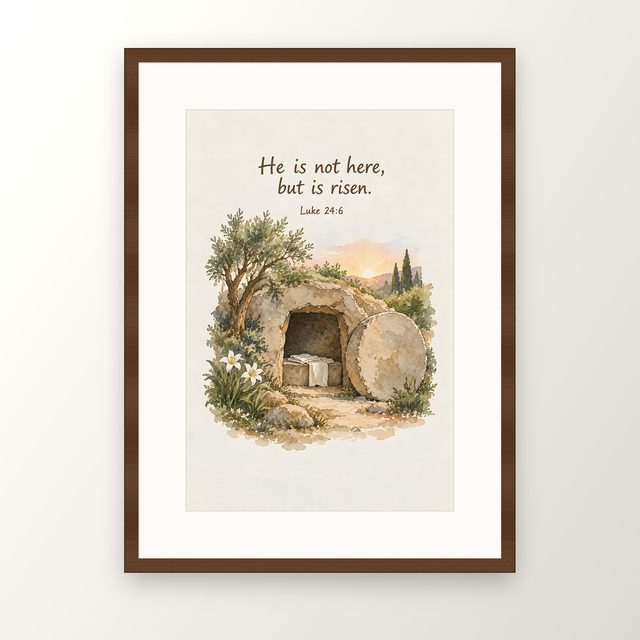
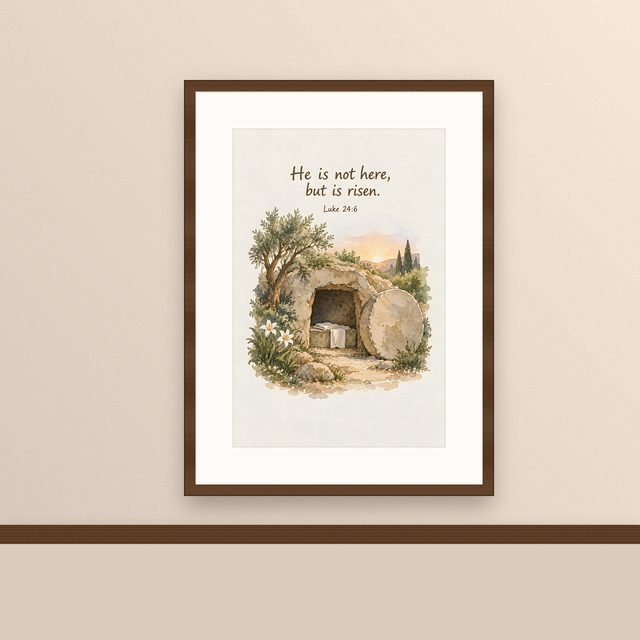
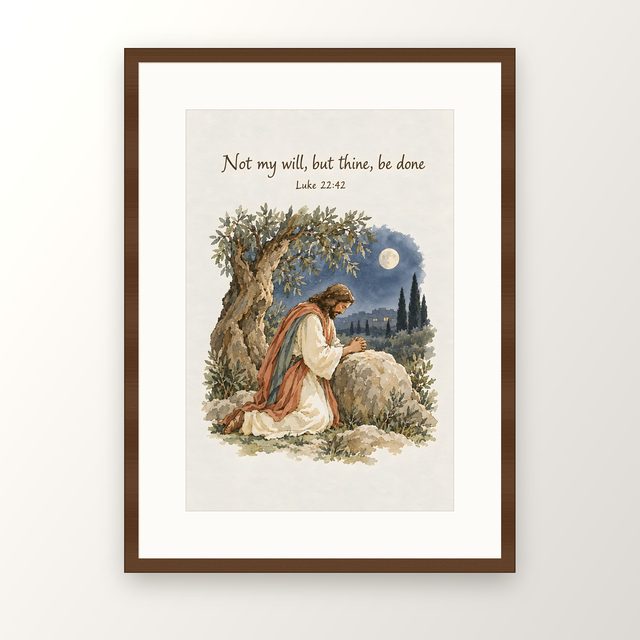
Hang them together
Complete the wall
Hang three together and save 25% on your prints.