Bible verse wall art
John 19: the crucifixion in John's Gospel
John 19 is the center of Good Friday. It takes Jesus from Pilate's judgment seat to a garden tomb, and two of its lines are lettered on our prints: the road to Golgotha and the final word from the cross.
John 19 prints
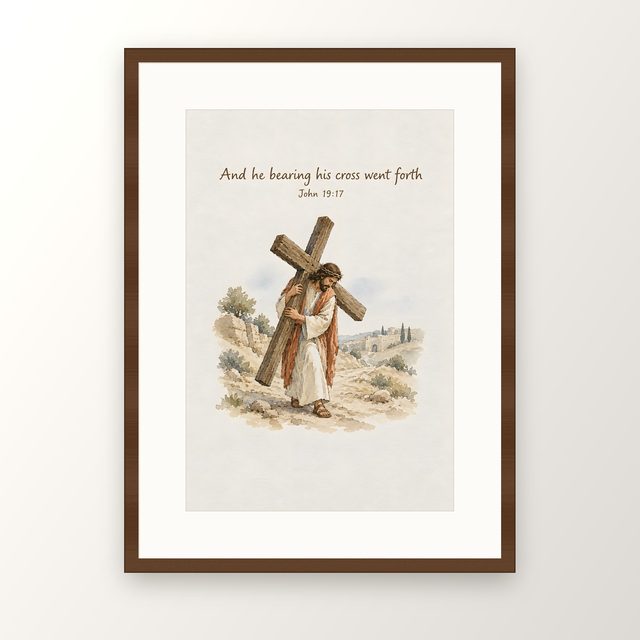
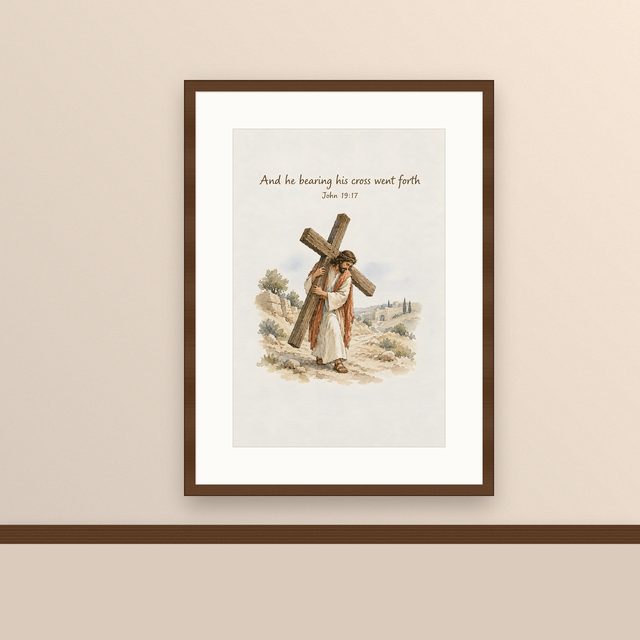
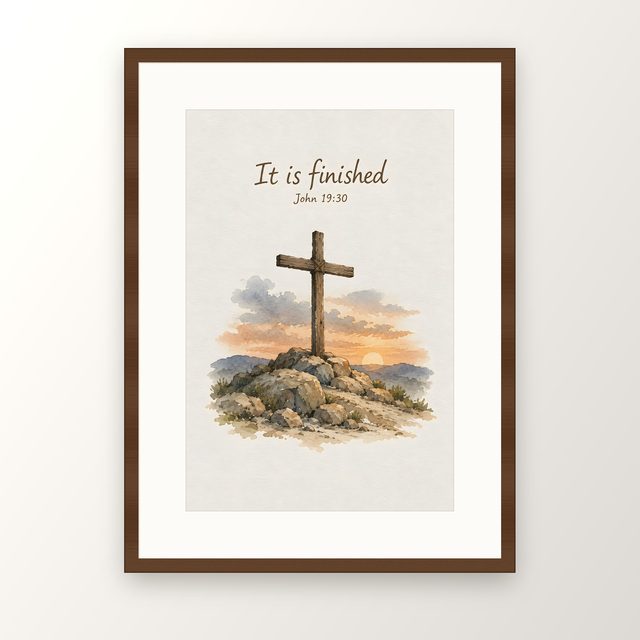
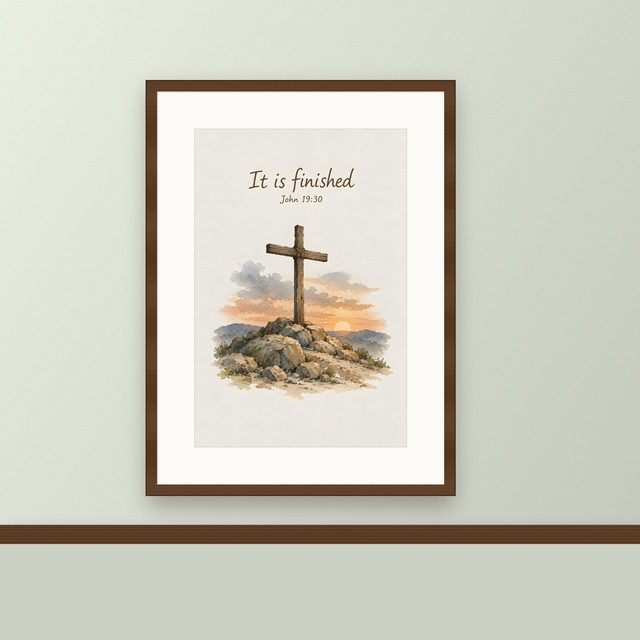
John 19 · King James Version
17 And he bearing his cross went forth
30 It is finished
Pilate, thorns and the title on the cross
The chapter opens with the scourging, the purple robe and the crown of thorns. Pilate presents Jesus to the crowd with the words “Behold the man,” remembered in Latin as Ecce homo. Pilate tries more than once to release him, but the cry that he is no friend of Caesar settles the matter. Above the cross Pilate fixes a title, Jesus of Nazareth, the King of the Jews, written in Hebrew, Greek and Latin so that anyone passing on the road could read it, and he refuses to change it.
What does “And he bearing his cross went forth” mean?
Verse 17 is short and deliberate. Condemned prisoners carried the crossbeam themselves, and John records that Jesus did so, walking out of the city to “a place called the place of a skull,” Golgotha in Hebrew. Matthew, Mark and Luke add that Simon of Cyrene was made to carry the cross for part of the way; John keeps the camera on Jesus alone. The devotion called the Stations of the Cross, fourteen stops along this road, grew out of pilgrims retracing the route through Jerusalem, and many churches pray it on the Fridays of Lent.
What does “It is finished” mean in John 19:30?
At the foot of the cross John places Mary, her sister, Mary Magdalene and the beloved disciple, and Jesus entrusts his mother and that disciple to each other. He says “I thirst,” is offered vinegar, and then speaks his last word in this Gospel. In the Greek of the New Testament it is a single word, tetelestai, used of work completed or a debt paid in full. It is not a sigh of defeat but the statement that the task is done, and John adds that Jesus bowed his head and gave up the ghost.
That sense of a debt settled is behind the nineteenth-century hymn “Jesus Paid It All,” written by Elvina Hall, whose title our second print borrows.
Burial, and the threads back to the Old Testament
A soldier pierces Jesus's side, and blood and water come out. John notes the fulfillment of Scripture more often here than anywhere else: the garments divided by lot recall Psalm 22, the unbroken bones recall the Passover lamb of Exodus 12, and the pierced side recalls Zechariah 12. Joseph of Arimathea and Nicodemus then wrap the body with spices and lay it in a new tomb in a garden. In Catholic, Anglican and Lutheran churches the whole Passion according to John is read aloud on Good Friday.