Bible verse wall art
1 Corinthians 13: the love chapter
Most people know it as “love is patient, love is kind”. The King James says “charity suffereth long”, and the older wording turns out to explain a lot about what Paul meant.
1 Corinthians 13 print
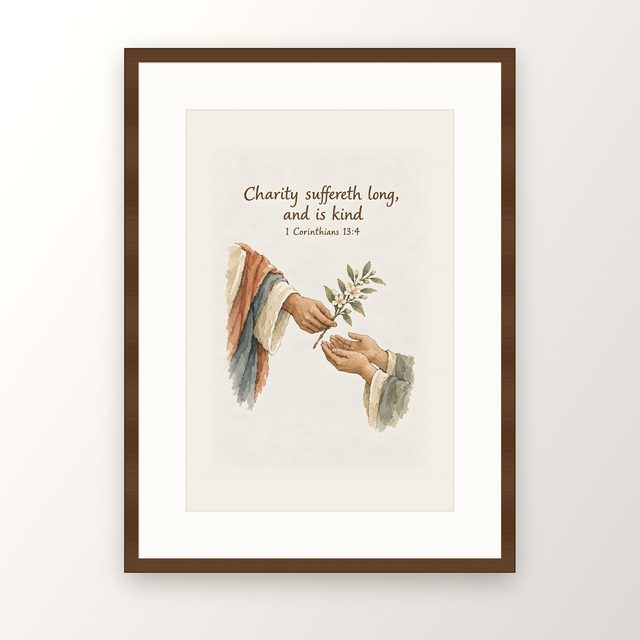
1 Corinthians 13 · King James Version
4 Charity suffereth long, and is kind
Why Paul wrote about love
Chapter 13 is not a stand-alone poem. It sits between two chapters about spiritual gifts, where Paul is dealing with a church in Corinth that competed over who spoke in tongues, who prophesied, and who had the most impressive abilities. Chapter 12 ends with a promise to show them “a more excellent way”, and chapter 13 is that way.
The first three verses are almost harsh. Eloquence, prophecy, faith that moves mountains, even giving everything to the poor: without love, Paul says, all of it amounts to nothing. Only after clearing the ground does he describe what love actually looks like.
What does “charity suffereth long” mean?
The Greek word is agape, a steady, self-giving love rather than romance or friendship. The translators of 1611 followed the Latin caritas and wrote “charity”, which at the time meant love in its fullest sense, not a donation. Modern versions switched to “love” because the English word charity has narrowed.
“Suffereth long” means puts up with a lot for a long time. The Greek verb describes someone who could retaliate and chooses not to, who has a long fuse. It is paired with kindness, which is the active side: patience holds back, kindness reaches out. Notice that Paul defines love by verbs, by what it does, and the list that follows in verses 5 to 7 is mostly things love refuses to do, such as envy, boast, keep score or rejoice in wrongdoing.
The chapter closes with three things that remain, faith, hope and charity, and names the last as the greatest.
Why it is read at so many weddings
Paul was writing to a congregation, not to a bride and groom, yet the passage became a fixture of Christian wedding ceremonies because it describes a love that lasts past the first feeling. Couples often choose verses 4 to 8, and it also turns up at anniversaries, vow renewals and, less often, at funerals, where the line about love never failing takes on a new weight.
Printed on a wall, the single phrase from verse 4 works as a quiet reminder in a bedroom or an entryway, the places where patience is tested most.
Love in the rest of the New Testament
Jesus names love for God and neighbor as the two great commandments (Matthew 22). John's first letter goes further and says that God is love. Paul himself lists love first among the fruit of the Spirit in Galatians 5, which suggests that for him patience and kindness were not personality traits but something the Spirit grows over time.