Bible verse wall art
1 Corinthians 15: “O death, where is thy sting?”
The longest chapter in any of Paul's letters is devoted to a single question: did Jesus really rise, and what does that mean for the rest of us? It ends with a taunt thrown at death itself.
1 Corinthians 15 print
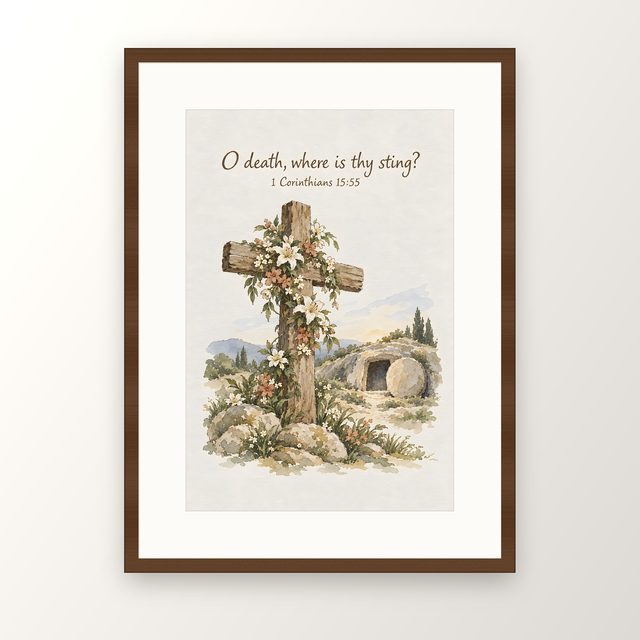
1 Corinthians 15 · King James Version
55 O death, where is thy sting?
The resurrection chapter
Some believers in Corinth had started saying there is no resurrection of the dead. Greek thought often pictured the soul escaping the body, and the idea of bodies being raised seemed crude. Paul answers with 58 verses, the fullest treatment of the subject in the New Testament.
He opens with a summary of the faith he had received: Christ died for our sins, was buried, and rose on the third day. Then he lists witnesses, Peter, the Twelve, a crowd of more than five hundred at once (most of them still alive, he notes, so they could be asked), James, and finally Paul himself. Many scholars consider verses 3 to 7 one of the earliest Christian creeds, handed down within a few years of the crucifixion.
What does “O death, where is thy sting?” mean?
The line comes at the climax of the chapter. Paul has argued that if Christ is not raised, faith is empty; that the risen Christ is the “firstfruits”, the first sheaf of a harvest still to come; and that the body sown in weakness will be raised in power, as different from the old as a plant is from its seed.
Then he breaks into something close to song. Verse 55 adapts a line from the prophet Hosea (Hosea 13:14) and turns it around: death is addressed like a defeated enemy and asked to show its weapon. The sting is the image of a scorpion or a bee, and verse 56 explains it: the sting of death is sin. Remove sin, and death loses what makes it deadly. Verse 57 gives thanks for the victory through Jesus Christ.
It is not a denial of grief. Paul is not saying death does not hurt, only that it does not have the last word.
Easter mornings and graveside services
The chapter is read at Easter in many churches and is one of the most common New Testament readings at Christian funerals. Handel set several of its verses in the final part of Messiah, including a duet on this very line. Families often choose the verse for memorial cards and sympathy gifts because it holds sorrow and hope in the same breath.
Connections across Scripture
Beyond Hosea, Paul echoes Isaiah 25:8, where God promises to swallow up death. The Gospel accounts of the empty tomb in Matthew 28, Mark 16, Luke 24 and John 20 are the events behind his argument, and Revelation 21 pictures the end point: a world where death shall be no more.