Bible verse wall art
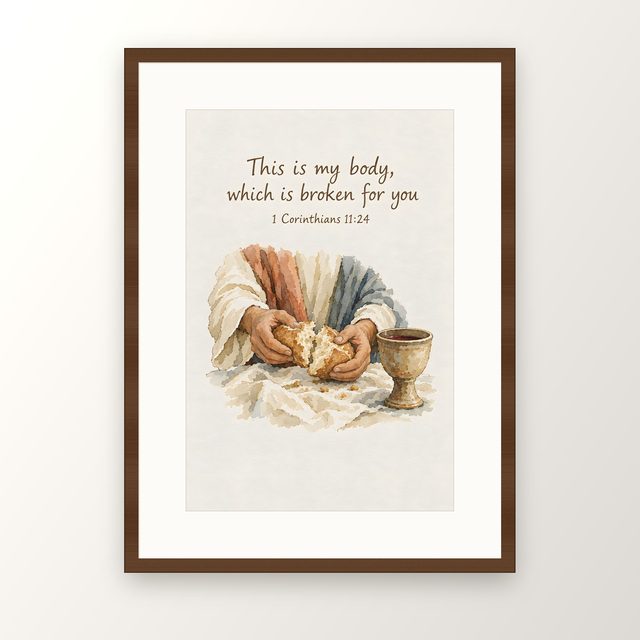
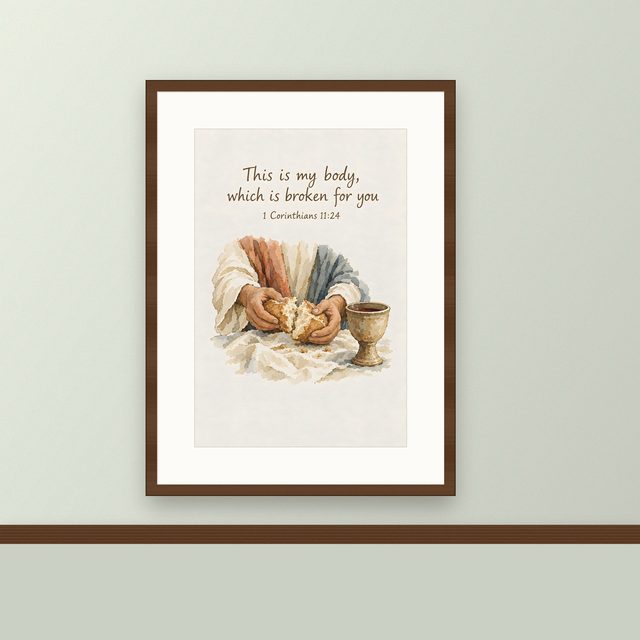
1 Corinthians 11: “This is my body, which is broken for you”
The oldest written account of the Last Supper is not in a Gospel. It sits in a letter Paul sent to a quarreling church in Greece, and its words are still spoken at Communion tables every Sunday.
1 Corinthians 11 print
1 Corinthians 11 · King James Version
24 This is my body, which is broken for you
A letter to a divided church
Paul founded the church in Corinth, a busy port city, around the year 50 and wrote to it a few years later from Ephesus. Most scholars date 1 Corinthians to the mid-50s, which makes it earlier than any of the four Gospels in their finished form. The believers there met in private homes and shared a full meal together before remembering Jesus.
That meal had gone wrong. Some members arrived early and ate everything, others went hungry, and a few drank too much. The wealthier guests seem to have treated the gathering like a private dinner party, while poorer members, likely laborers and slaves who came late, were left out. Paul is blunt about it in the second half of chapter 11: this is not the Lord's Supper at all.
What does 1 Corinthians 11:24 mean?
To correct them, Paul repeats a tradition he says he “received of the Lord” and had already passed on: on the night he was betrayed, Jesus took bread, gave thanks, broke it, and said the words printed on our poster. The phrase “broken for you” points to the cross. The bread is torn apart the way his body would be the next day, and it is given away, not kept.
Two small words carry weight. “For you” makes the gift personal and plural at once, since the Greek addresses the whole group. And the verse ends, in the King James, with the instruction to do this in remembrance of him. Remembering here is more than recalling a fact; it means bringing the event into the present so that the church lives by it.
Paul's point to Corinth follows from that. If the body was broken for everyone at the table, then a meal where some eat and others go hungry contradicts the very thing it celebrates.
The words at Communion today
These verses, 23 to 26, are known as the words of institution. Catholic, Orthodox, Lutheran, Anglican, Methodist, Baptist and many other churches use them, or the parallel Gospel wording, when they celebrate the Eucharist or the Lord's Supper. Traditions differ on how Christ is present in the bread and wine, and this page does not settle that debate, but almost all of them hear these lines at the table.
That is why the verse is often chosen for First Communion, for a church fellowship hall, or for a dining room where a family says grace.
The Last Supper across the New Testament
Matthew 26, Mark 14 and Luke 22 each tell the story of the final meal, and Luke's wording is the closest to Paul's. John's Gospel takes a different angle, describing Jesus washing the disciples' feet and calling himself the bread of life in chapter 6. Paul also returns to the theme in 1 Corinthians 10, where sharing one loaf makes many people into one body.