Bible verse wall art
Proverbs 31: strength and honour are her clothing
The book of Proverbs ends not with a king or a sage but with a portrait of a woman at work. Verse 25 is the line people remember, and it says more than it seems to.
Proverbs 31 print
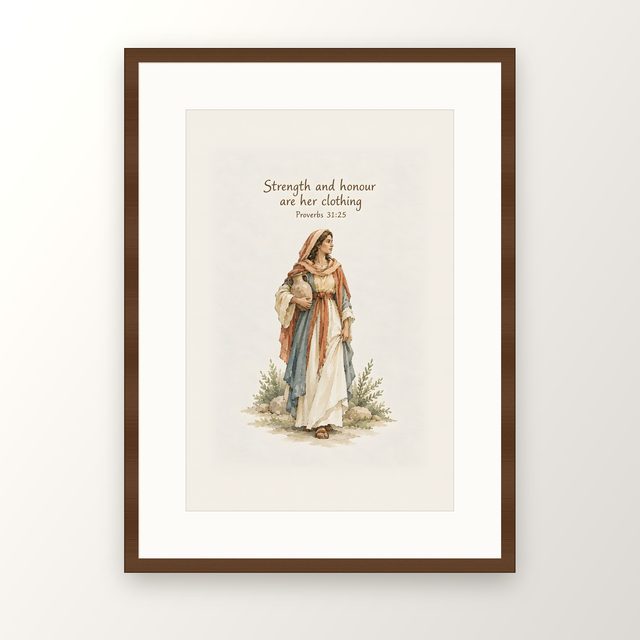
Proverbs 31 · King James Version
25 Strength and honour are her clothing
Lemuel's mother and an alphabet poem
The chapter opens with “The words of king Lemuel, the prophecy that his mother taught him” (31:1). A queen mother warns her son against wasting his strength on women and wine, and tells him to speak up for those who cannot speak for themselves.
Verses 10 to 31 are a separate poem, an acrostic: in Hebrew each of its twenty-two lines begins with the next letter of the alphabet, from aleph to tav. It opens with a question, “Who can find a virtuous woman? for her price is far above rubies.”
What does “virtuous” mean here?
The Hebrew is eshet chayil. Chayil is a word used elsewhere for armies, wealth and valor, so the phrase suggests a woman of strength or substance more than simply a well-behaved one. Proverbs 12:4 uses it too, and the only named woman who receives the title is Ruth (Ruth 3:11).
The poem shows her buying a field and planting a vineyard with her own earnings, trading cloth, rising before dawn, and opening her hand to the poor (31:20). She is a manager and a merchant as much as a homemaker.
Strength and honour are her clothing
The complete verse is: “Strength and honour are her clothing; and she shall rejoice in time to come.” Earlier in the poem she makes scarlet clothes for her household and fine linen for herself. Here the image turns inward. What she really wears is strength and dignity, and they do not wear out.
The second half is often overlooked. In time to come she will rejoice, or in many modern translations, she laughs at the days ahead. Having prepared well, she can face the future without fear. The poem closes on what matters most: “Favour is deceitful, and beauty is vain: but a woman that feareth the LORD, she shall be praised” (31:30).
How it is used today
In many Jewish homes, husbands and children sing Eshet Chayil to the woman of the house on Friday evening before the Sabbath meal. In churches the passage is read on Mother's Day, at women's retreats and often at the funeral of a mother or grandmother, when a family recognizes in it the woman they have lost. A print of verse 25 is a natural gift for a mother, a wife, a mentor or a new graduate stepping into her own work.