I Am the Bread of Life, John 6:35 Wall Art
John 6:35 · King James Version Free US shipping
“I am the bread of life”
John 6:35
Build a gallery wall: save 25% on 3 prints or more, applied in your cart.
- Free US shipping
- Printed in the USA
- 30-day returns
- King James text, checked
- 6
- words of Scripture
- 2
- prints from John 6
- $29
- smallest print
- 2–5
- days to dispatch
The print
A giclée print on thick archival matte paper of at least 200gsm. The verse is set into the painting in the King James Version, with a blank paper margin that makes framing easy. Sold without a frame.
Shipping
Printed to order and shipped within 2 to 5 business days, from a print studio in the United States. Shipping is free on every order.
Returns
Returns accepted within 30 days of delivery.
Digital download
Seven high-resolution files covering every common frame ratio, 4096 × 6144 px, good for printing up to A1. Nothing is shipped.
About this print
I Am the Bread of Life, John 6:35
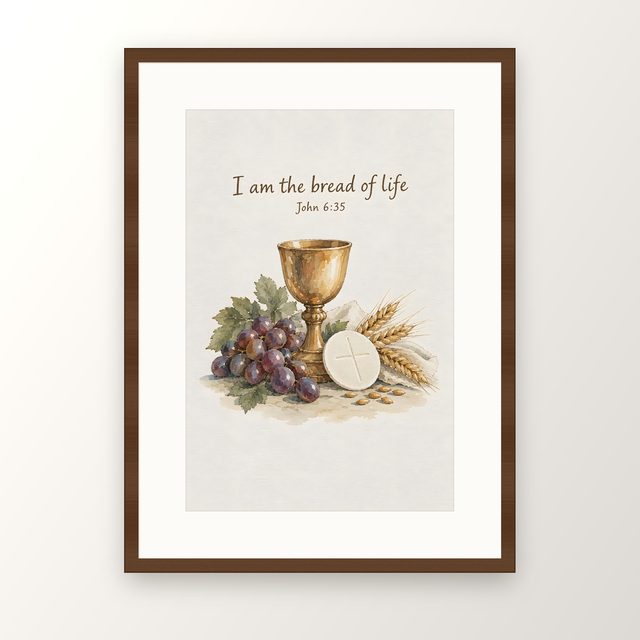
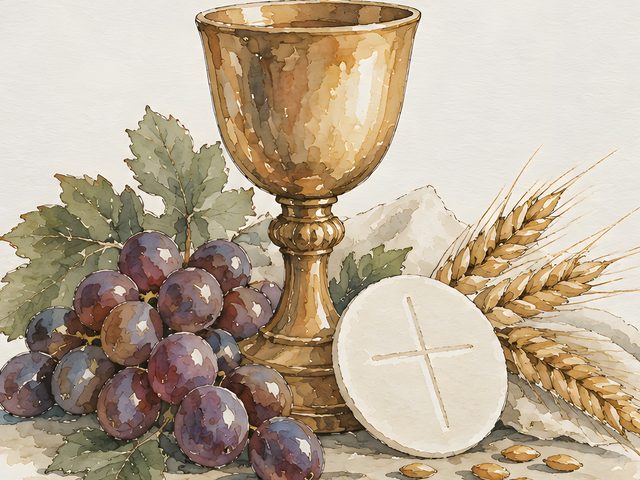
Chalice, host, wheat and grapes gathered in warm watercolor, under the words Jesus spoke the day after he fed five thousand people.
A still life of the altar
At the center stands a gilded chalice with a knotted stem, its bowl catching the light in streaks of amber and ocher. Leaning against its foot is a round white host marked with a thin cross, pressed into the wafer rather than painted on. To the left, a heavy bunch of purple grapes spills over its own vine leaves; to the right, ears of ripe wheat rest on a fold of linen, with a few loose grains scattered in front.
The whole arrangement sits on a pale wash of sand color with generous white paper above it. The words “I am the bread of life” are lettered in a relaxed brown script, John 6:35 set smaller below.
Why did Jesus call himself bread?
In the King James Version the whole verse reads: “And Jesus said unto them, I am the bread of life: he that cometh to me shall never hunger; and he that believeth on me shall never thirst.” It comes in a long conversation at Capernaum, the morning after the feeding of the five thousand by the Sea of Galilee. The crowd follows Jesus hoping for more loaves, and brings up the manna their ancestors ate in the wilderness. His answer turns the conversation from the bread he gave to the giver himself.
John records seven such “I am” statements, and this is the earliest; the others name him the light of the world, the door, the good shepherd, the resurrection and the life, the way, the truth and the life, and the true vine. Each takes an ordinary image and fills it with meaning; bread was the most ordinary of all, eaten at every meal in first-century Galilee.
Later in the same chapter Jesus speaks of eating his flesh and drinking his blood, and many listeners walk away. Catholic and Orthodox Christians read the chapter as teaching on the Eucharist, which is why the painting shows a chalice and host; many Protestants read it chiefly as a call to faith. Both readings meet in the promise that whoever comes to him will not go hungry.
A keepsake for First Communion
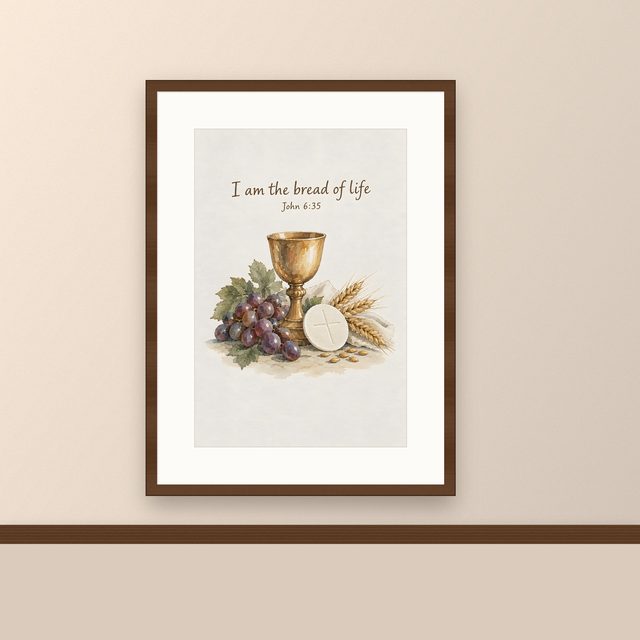
Parents and godparents often look for something a child can keep long after the white dress or suit no longer fits. With its chalice and host, this print marks the day a child first receives the sacrament, and it grows up well: nothing in it is babyish. A dining room or kitchen wall, near the table where the family eats together, suits it just as naturally.
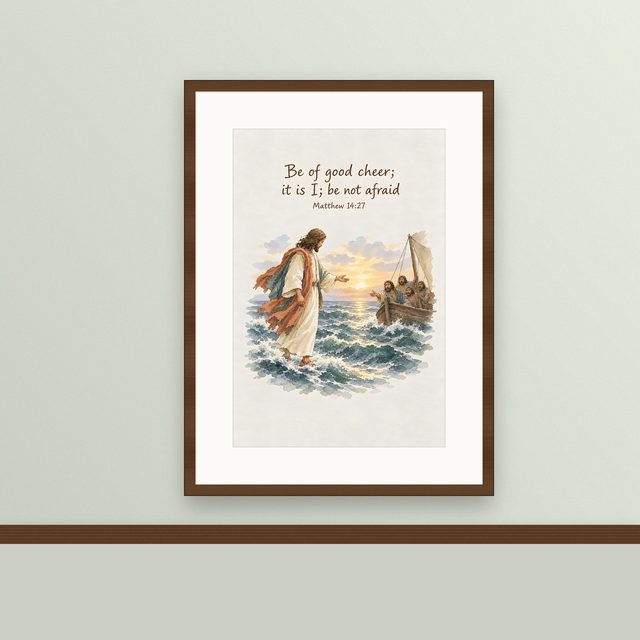
Hang them together
Complete the wall
Hang three together and save 25% on your prints.