Bible verse wall art
John 6: I am the bread of life
John 6 begins with a hillside picnic for thousands and ends with most of the crowd walking away. In between, Jesus says the first of the great “I am” sayings of the fourth Gospel, about bread.
John 6 prints
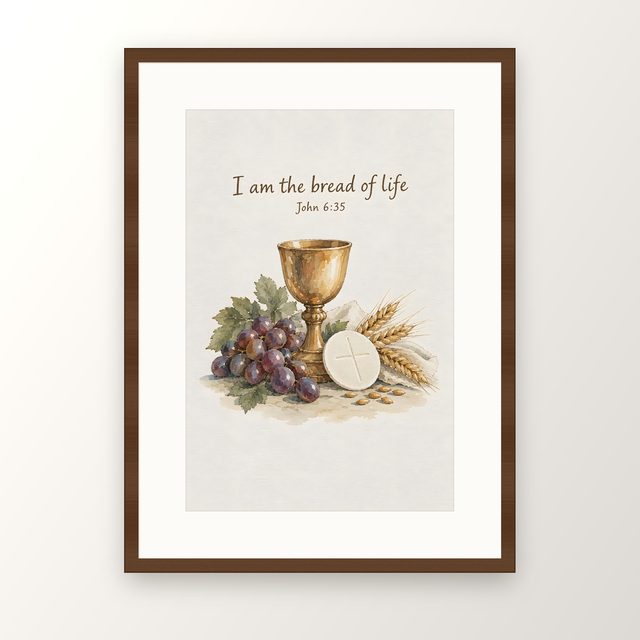
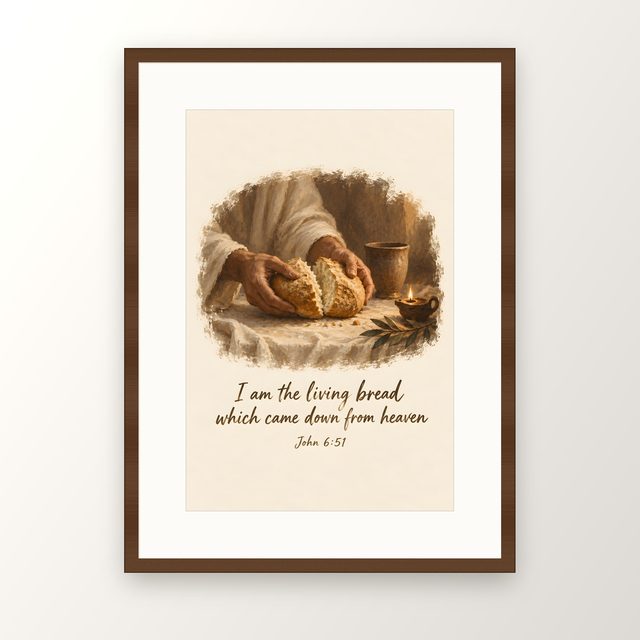
John 6 · King James Version
35 I am the bread of life
Loaves, fish and a lake at night
The chapter is set near the Sea of Galilee, shortly before Passover. A great crowd follows Jesus, and with five barley loaves and two small fishes offered by a boy, he feeds about five thousand men; twelve baskets of leftovers are gathered. This is the only miracle of Jesus's ministry, apart from the resurrection, that all four Gospels record.
That night the disciples row across the lake without him, and Jesus comes to them walking on the water, telling them, “It is I; be not afraid.” The next day the crowd finds him again in Capernaum, and the long conversation of the chapter takes place in the synagogue there (verse 59).
What does “I am the bread of life” mean?
The crowd wants another sign and brings up the manna their ancestors ate in the desert under Moses. Jesus answers that the true bread from heaven is not a food that spoils overnight but a person. In verse 35 he says, I am the bread of life, and promises that whoever comes to him will never hunger and whoever believes in him will never thirst.
Bread in the ancient Mediterranean was not a side dish; it was most of what people ate in a day. To call yourself bread is to say you are what keeps a person alive. The phrase “I am” also matters in John. It echoes the name God gives Moses at the burning bush, and Jesus will repeat the pattern with light, door, shepherd, resurrection, way and vine.
Eucharist, First Communion and a hard saying
From verse 51 on, the language grows more concrete: the bread is his flesh, given for the life of the world, and those who eat his flesh and drink his blood have eternal life. Catholic and Orthodox Christians read this passage as teaching about the Eucharist, and it is a common reading for First Communion. Many Protestant traditions read it first as a picture of faith, of taking Christ in by trusting him, while also connecting it to the Lord's Supper.
The listeners find the words difficult, and many disciples stop following him. Jesus asks the twelve whether they will leave too, and Peter answers with one of the most honest confessions in the Gospels: Lord, to whom shall we go? thou hast the words of eternal life.
Bread from Exodus to the Lord's Prayer
The chapter leans on Exodus 16, where God sends manna each morning, enough for one day only. The same daily rhythm sits inside the Lord's Prayer, give us this day our daily bread, and in the Last Supper accounts of the other Gospels, where Jesus takes bread, gives thanks and breaks it. A print of John 6:35 belongs naturally in a dining room or kitchen, or as a gift for a child's First Communion.