Crucifixion, Luke 23:34 Wall Art
Luke 23:34 · King James Version Free US shipping
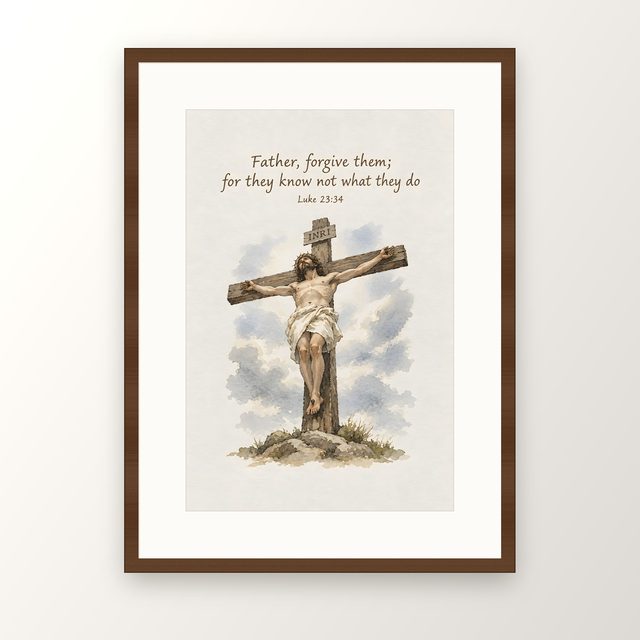
“Father, forgive them; for they know not what they do”
Luke 23:34
Build a gallery wall: save 25% on 3 prints or more, applied in your cart.
- Free US shipping
- Printed in the USA
- 30-day returns
- King James text, checked
- 10
- words of Scripture
- 1
- print from Luke 23
- $29
- smallest print
- 2–5
- days to dispatch
The print
A giclée print on thick archival matte paper of at least 200gsm. The verse is set into the painting in the King James Version, with a blank paper margin that makes framing easy. Sold without a frame.
Shipping
Printed to order and shipped within 2 to 5 business days, from a print studio in the United States. Shipping is free on every order.
Returns
Returns accepted within 30 days of delivery.
Digital download
Seven high-resolution files covering every common frame ratio, 4096 × 6144 px, good for printing up to A1. Nothing is shipped.
About this print
Crucifixion, Luke 23:34
A watercolor of Christ on the cross, lettered with the first words he spoke from it: a prayer for the people who put him there.
The scene on the paper
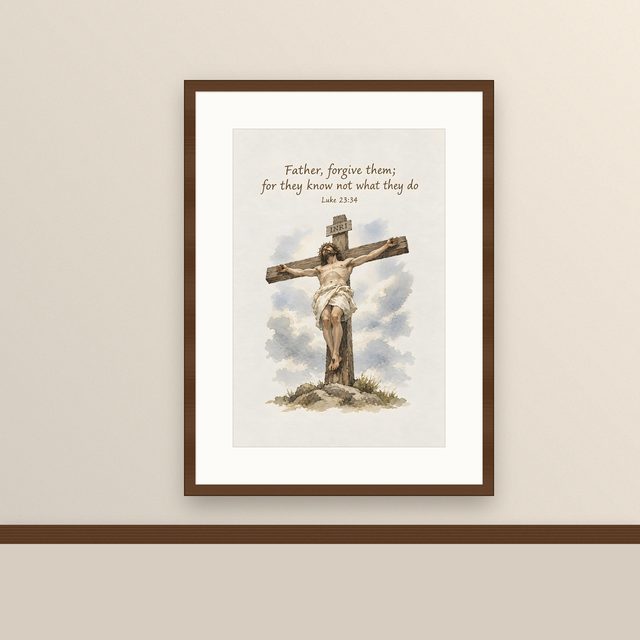
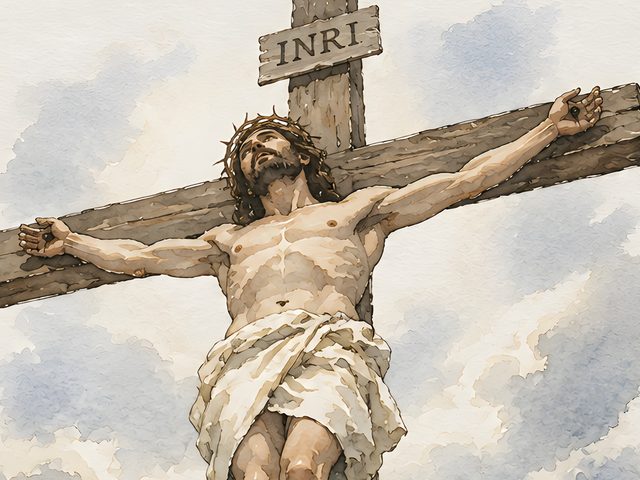
The cross stands on a small mound of gray rock and dry grass, its beams left rough and knotted like timber that was never meant to be looked at. Jesus hangs with his arms stretched almost level, head bowed to one side under a crown of thorns, a cream loincloth knotted at his hip. Nailed above him is a weathered board carved with four letters, INRI.
Behind the figure, the artist has laid in a sky of soft slate-blue clouds that fade into the bare paper, so the cross seems to stand in open air with nothing else around it. Over the top, in brown hand lettering: “Father, forgive them; for they know not what they do”, with Luke 23:34 underneath.
What does Luke 23:34 mean?
Luke writes it this way in the 1611 translation: “Then said Jesus, Father, forgive them; for they know not what they do. And they parted his raiment, and cast lots.” The two halves sit side by side on purpose. While the soldiers at his feet are dividing his clothes, Jesus is praying for them. Luke is the only Gospel writer to record this sentence, and it echoes his account of Stephen, the first martyr, who prays in Acts 7 that the sin of his killers not be held against them.
Tradition counts this line as the first of the Seven Last Words, the seven sayings of Jesus on the cross gathered from all four Gospels. Many Catholic and Protestant churches meditate on them one by one during a three-hour service on Good Friday. A few early Greek manuscripts leave the prayer out, which scholars discuss openly, yet it has been read and preached in the Church since its earliest centuries.
As for INRI: John 19 says Pilate had a title fixed to the cross in Hebrew, Greek and Latin. The letters abbreviate the Latin, Iesus Nazarenus Rex Iudaeorum, “Jesus of Nazareth, King of the Jews”.
For Lent, Easter and the home
This is a crucifix image in the traditional Catholic sense, with the body of Christ shown, which makes it a natural fit for a prayer corner, a hallway near the front door or the wall above a family altar. Some households bring it out at Ash Wednesday and keep it up through Holy Week.
Because the verse is about forgiveness rather than suffering, it also speaks to anyone working through a broken relationship. Godparents sometimes give it at a baptism, as a reminder of the mercy the child is baptized into.
Hang them together
Complete the wall
Hang three together and save 25% on your prints.