Bible verse wall art
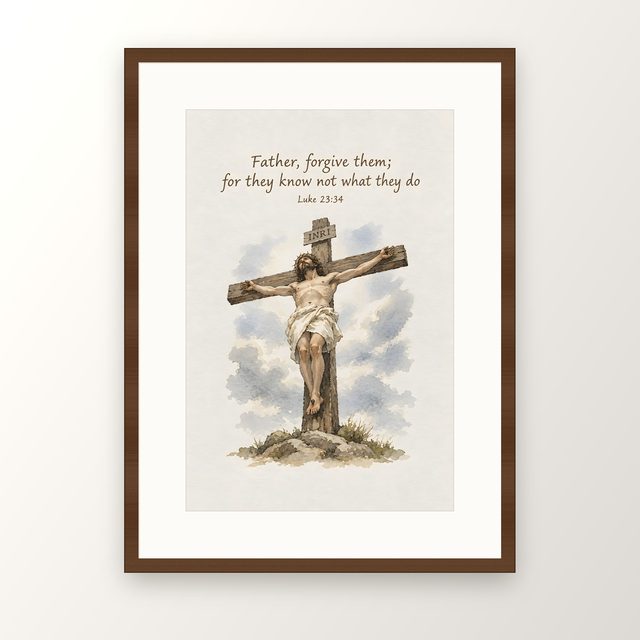
Luke 23: Father, forgive them
Luke's account of the crucifixion is the one that dwells most on mercy. Of the seven sayings of Jesus on the cross that Christians remember, three are found only here, and the first is a prayer for the people nailing him to it.
Luke 23 print
Luke 23 · King James Version
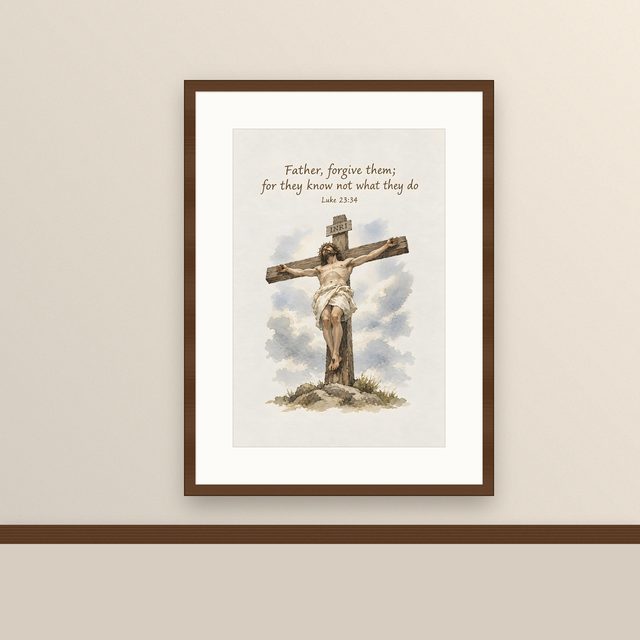
34 Father, forgive them; for they know not what they do
Two trials and a crowd
Jesus is brought before Pontius Pilate, the Roman governor, who finds no fault in him. Hearing that Jesus is a Galilean, Pilate sends him to Herod Antipas, the ruler of Galilee, who happens to be in Jerusalem; Luke is the only Gospel to record this hearing. Herod mocks him, dresses him in a gorgeous robe and sends him back, and Luke notes dryly that Pilate and Herod became friends that very day. The crowd demands the release of Barabbas instead, and Pilate gives in.
On the road out of the city, Simon of Cyrene is made to carry the cross, and a group of women follow weeping. Jesus turns to them and tells the daughters of Jerusalem to weep not for him but for themselves and their children.
What does “Father, forgive them” mean?
At the place called Calvary, Jesus is crucified between two criminals. Verse 34 records his words: Father, forgive them; for they know not what they do. The prayer is addressed to God, not to the soldiers, and it asks for pardon while the wrong is still being done. It puts into practice what Jesus taught in Luke 6: love your enemies and pray for those who mistreat you.
Some early manuscripts of Luke do not contain this sentence, and modern Bibles sometimes mark it with a note. It has nonetheless been part of Christian reading and preaching since the second century, and very few sayings of Jesus have shaped Christian ethics more.
The other two sayings found only in Luke follow. One criminal mocks him, but the other asks to be remembered, and Jesus answers, To day shalt thou be with me in paradise. At the end, after darkness has covered the land from the sixth hour to the ninth, he cries, Father, into thy hands I commend my spirit, a line taken from Psalm 31.
Good Friday and the Seven Last Words
Many churches hold a Good Friday service built on the seven last words, gathered from all four Gospels, often between noon and three o'clock. The sayings from Luke 23 are also frequent choices for Lenten devotions. A crucifixion print lettered with verse 34 is a sober reminder that forgiveness can begin in the worst moment rather than after it.
Forgiveness passed on
The prayer echoes quickly through the New Testament. In Acts 7, Stephen, the first Christian martyr, prays as he is stoned, Lord, lay not this sin to their charge. The Roman centurion at the cross says that this was a righteous man, and Joseph of Arimathea, a council member who had not agreed with the verdict, lays the body in a new tomb as the Sabbath begins.