Bible verse wall art
John 10: the Good Shepherd
In John 10 Jesus stops telling stories about shepherds and simply says he is one. Here is how the chapter unfolds, what verse 11 promises, and why this image has lasted so long in Christian homes.
John 10 prints
John 10 · King James Version
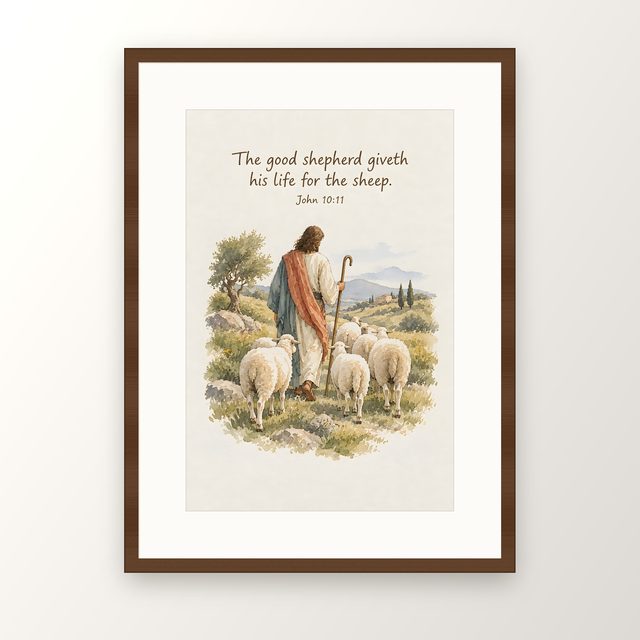
11 The good shepherd giveth his life for the sheep.
Where John 10 sits in the Gospel
The chapter follows straight on from John 9, where Jesus heals a man born blind and the religious leaders throw the healed man out of the synagogue. John 10 is Jesus's answer to that scene: the leaders who should have cared for the man behaved like hired hands, and Jesus sets out what a true shepherd looks like. Later in the chapter (verse 22) the setting moves to the Feast of the Dedication in winter, the festival Jewish families still keep today as Hanukkah.
What does John 10:11 mean?
The first verses describe a walled sheepfold with one gate. Jesus calls himself the door of the sheep, and then, in verse 10, contrasts himself with the thief who comes to steal and destroy: he has come so that his sheep may have life, and have it more abundantly.
Verse 11 goes further. The printed words, “The good shepherd giveth his life for the sheep,” describe a shepherd who does not run when the wolf arrives. A hired man counts the cost and leaves; the owner stays because the flock is his. Christians have always read the line as a quiet announcement of the cross, and verse 18 makes that explicit: no one takes his life from him, he lays it down of himself.
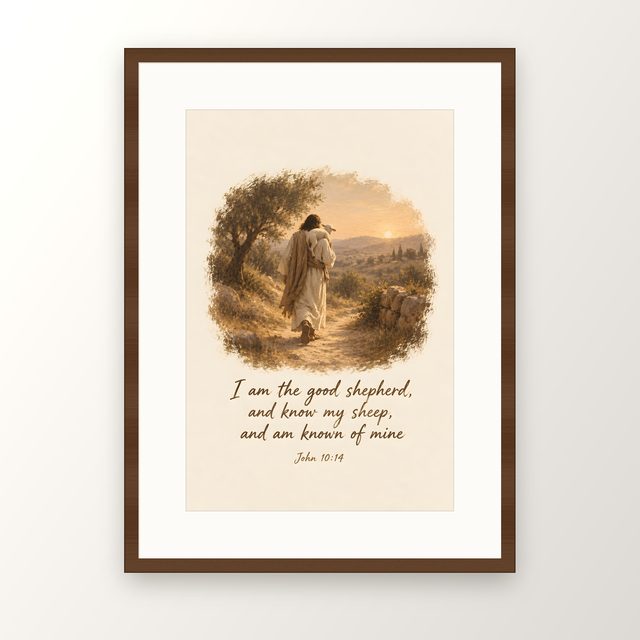
Two other details are easy to miss. In verse 14 the shepherd knows his sheep by name and they know his voice, which is how a Middle Eastern flock actually behaves. And in verse 16 Jesus mentions “other sheep” outside this fold, a hint that the flock will grow far beyond one nation.
Good Shepherd Sunday and the catacombs
Many churches set aside the fourth Sunday of Easter as Good Shepherd Sunday, when a portion of John 10 is read aloud. The image is also one of the oldest in Christian art: young shepherds carrying a lamb across their shoulders were painted on the walls of the Roman catacombs long before crosses and crucifixes became common. A John 10:11 print carries that long tradition into a nursery, a pastor's study or a memorial corner.
The shepherd thread through Scripture
Jesus was drawing on a picture his hearers knew well. Psalm 23 opens with the Lord as shepherd, and Ezekiel 34 condemns the shepherds of Israel who fed themselves instead of the flock, promising that God himself will search for his scattered sheep. After the resurrection the idea continues: Hebrews 13:20 calls Jesus “that great shepherd of the sheep,” and the first letter of Peter names him the chief Shepherd.