Bible verse wall art
John 9: the man born blind and “now I see”
John 9 tells a healing story, but most of the chapter is an investigation. The man who could not see ends up seeing more clearly than the experts questioning him.
John 9 print
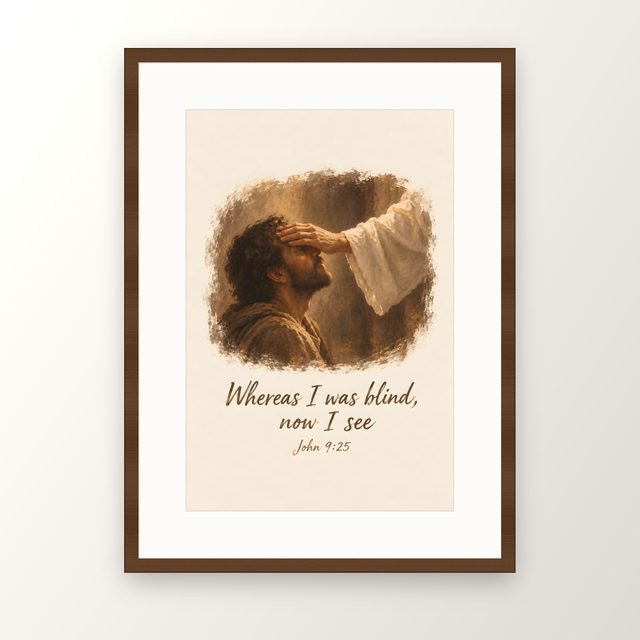
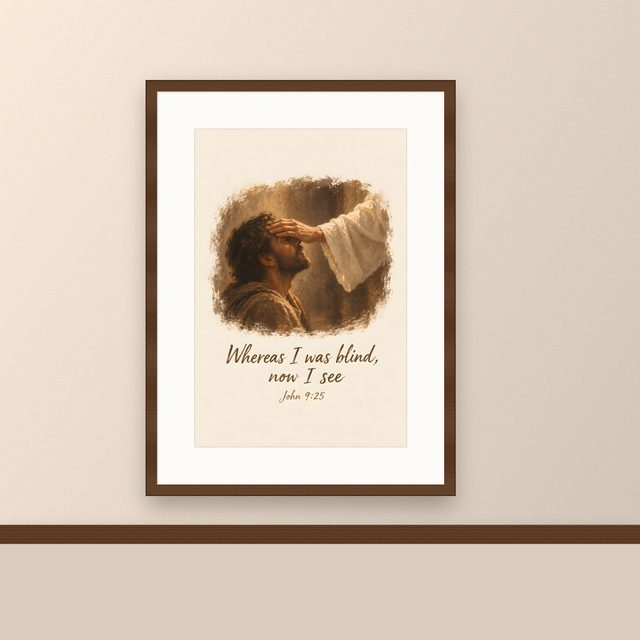
John 9 · King James Version
25 Whereas I was blind, now I see
Who sinned?
Jesus and his disciples pass a man who has been blind from birth. The disciples ask a question common in their day: who sinned, this man or his parents? Jesus rejects both options. Neither hath this man sinned, nor his parents, he says, but that the works of God should be made manifest in him. Then he adds, As long as I am in the world, I am the light of the world.
He spits on the ground, makes clay, anoints the man's eyes and tells him to wash in the pool of Siloam, a name John translates as Sent. The man goes, washes and comes back seeing.
An interrogation on the sabbath
The healing took place on a sabbath, and the Pharisees are divided. Some say a man who breaks the sabbath cannot be from God; others ask how a sinner could do such miracles. They question the man, then his parents, who are afraid of being put out of the synagogue and say only that he is of age and can speak for himself.
They call the man back and press him to say Jesus is a sinner. His reply is the line on our print, in full: whether he be a sinner or no, I know not; one thing I know, that, “Whereas I was blind, now I see.” He will not argue theology he does not know. He will only testify to what happened to him. When he pushes back with growing boldness, they cast him out.
What John 9:25 means
The verse is the heart of personal testimony: not a complete explanation, but a changed life that cannot be denied. Jesus then finds the man, asks whether he believes on the Son of God, and the man worships him. The chapter ends by turning the idea of blindness around: those who claim to see are the ones who remain blind.
John Newton borrowed this very contrast for the last line of the first verse of “Amazing Grace,” which is one reason the words are so familiar.
The Healing Touch
Our Healing Touch painting shows Jesus resting his hand on the man's forehead as he lifts his face toward the light. As Christian wall art it suits a testimony wall, a recovery milestone, a baptism or the home of someone who can point to a before and after in their own life. John continues the shepherd theme straight into chapter 10, where Jesus contrasts himself with the leaders who drove this man out.