Bible verse wall art
Matthew 14: be of good cheer; it is I; be not afraid
Matthew 14 moves from a royal banquet that ends in murder to a hillside meal for thousands, and then to a boat in the middle of a wind-tossed lake at the darkest hour of the night.
Matthew 14 print
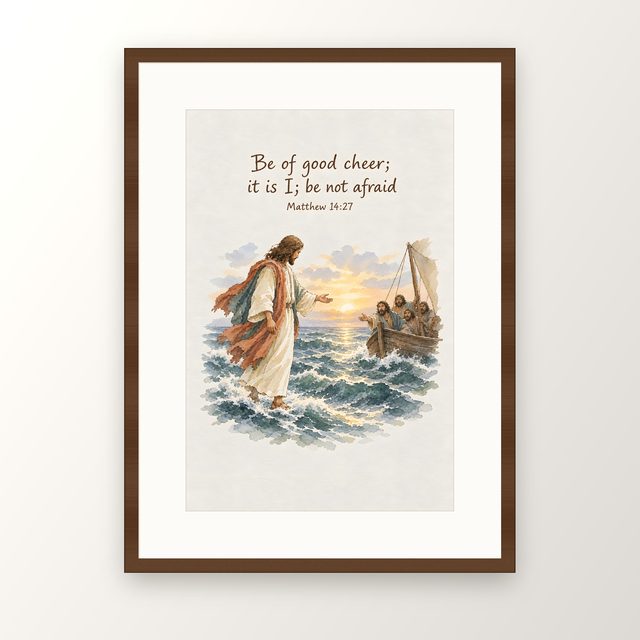
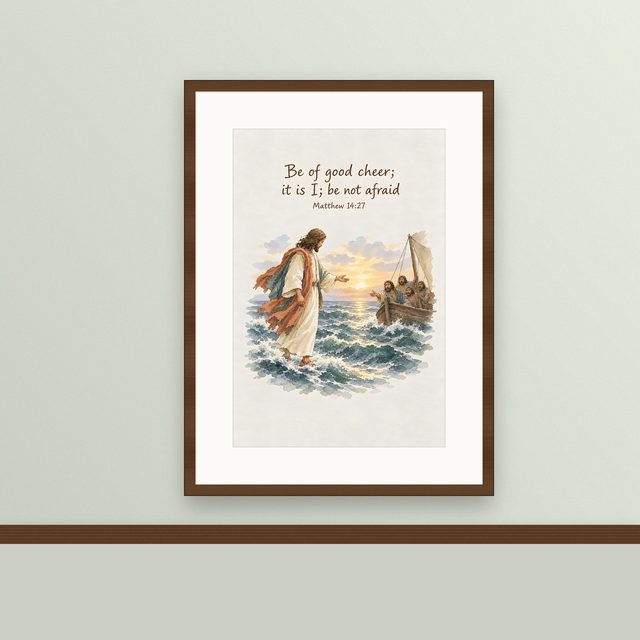
Matthew 14 · King James Version
27 Be of good cheer; it is I; be not afraid
Grief, then a crowd
The chapter begins with the death of John the Baptist. Herod Antipas had imprisoned John for condemning his marriage to Herodias; at a birthday feast her daughter dances, Herod rashly promises her anything, and at her mother's prompting she asks for John's head on a platter. When Jesus hears the news, he withdraws by boat to a quiet place, clearly wanting to be alone.
The crowds follow on foot. Moved with compassion, he heals their sick and, as evening comes, feeds about five thousand men, besides women and children, with five loaves and two fishes. Then he sends the disciples ahead by boat and goes up a mountain alone to pray.
What does “Be of good cheer; it is I; be not afraid” mean?
The boat is in the middle of the sea, tossed with waves, the wind against it. In the fourth watch of the night, somewhere between three and six in the morning, Jesus comes to them walking on the sea. The disciples cry out in fear, thinking they see a spirit. Straightway he speaks to them, and verse 27 gives his three short sentences: Be of good cheer; it is I; be not afraid.
The middle phrase is more than an identification. In Greek it reads ego eimi, literally “I am,” the same words that recall the name God revealed to Moses. Walking on water carries the same weight: in Job 9 God alone treads on the waves of the sea. The comfort Jesus gives is not that the storm is small, but that the one who rules it has arrived.
Peter steps out
Only Matthew tells what happens next. Peter asks to come to him on the water, and Jesus says, Come. Peter walks, but when he sees the wind boisterous he is afraid, begins to sink and cries, Lord, save me. Immediately Jesus stretches out his hand, catches him, and asks gently, O thou of little faith, wherefore didst thou doubt? When they climb into the boat, the wind stops, and those in the boat worship him, saying that he truly is the Son of God.
Many readers find themselves in Peter: brave enough to step out, human enough to look at the waves. That is why this print is often chosen for someone facing a leap of faith, a new venture or a frightening diagnosis.
Echoes across the Bible
Mark 6 and John 6 also tell of Jesus walking on the water. The words “fear not” are among the most repeated commands in Scripture, spoken to Abraham, to Joshua, to Mary and to the shepherds. The chapter closes at Gennesaret, where the sick simply touch the hem of his garment and are made whole.