Bible verse wall art
Matthew 21: Hosanna to the Son of David
Matthew 21 opens the last week of Jesus's life. The crowds line the road into Jerusalem shouting one Hebrew word that Christians still sing every Palm Sunday, and in many churches every Sunday: Hosanna.
Matthew 21 print
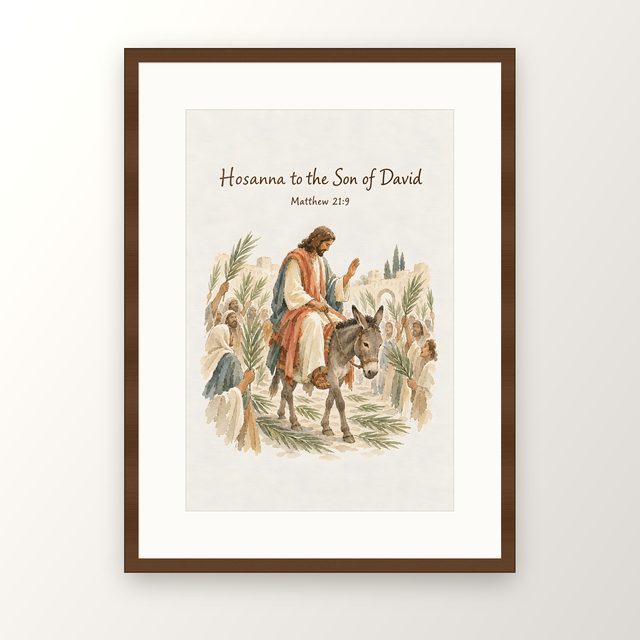
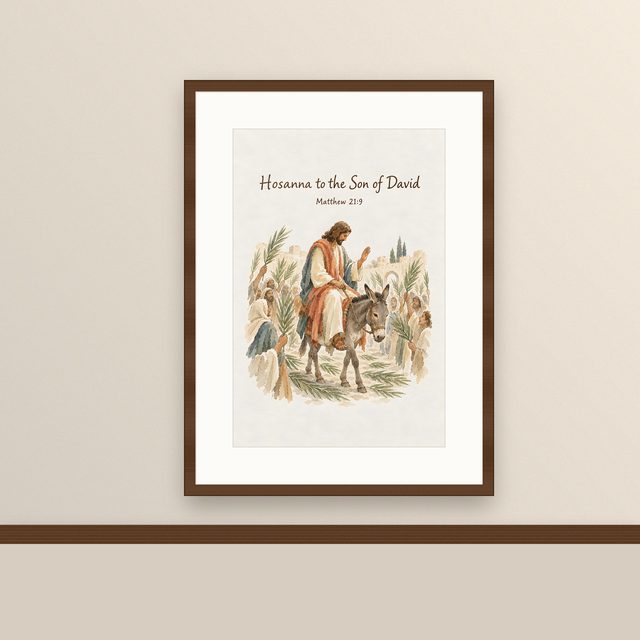
Matthew 21 · King James Version
9 Hosanna to the Son of David
A king on a donkey
Jesus and his disciples come near Jerusalem, to Bethphage on the Mount of Olives. He sends two disciples to a village to bring an ass and her colt. Matthew explains that this fulfills the prophet Zechariah (9:9): the king of Jerusalem is coming, meek, and sitting upon an ass. Conquerors rode war horses; a donkey signaled a king who came in peace.
A very great multitude spreads their garments on the road, while others cut down branches from the trees and strew them in the way. Laying cloaks before a rider was an old sign of honoring a king, as when Jehu was proclaimed in 2 Kings 9. John's Gospel specifies that the branches were palms, which is where Palm Sunday takes its name.
What does “Hosanna” mean?
The crowds before and behind cry out in verse 9: Hosanna to the Son of David: Blessed is he that cometh in the name of the Lord; Hosanna in the highest. “Hosanna” is a Hebrew plea meaning roughly “save, please” or “save now,” taken from Psalm 118:25, a psalm pilgrims sang on their way up to the temple at the great feasts. Over time the word had become a shout of praise as much as a prayer.
“Son of David” is a royal title for the Messiah, the heir promised to David's line. The crowd, in other words, is openly greeting Jesus as the long-awaited king. The whole city is stirred and asks, Who is this? Days later, a crowd in the same city will call for his crucifixion.
Palm Sunday and the Sanctus
On the Sunday before Easter, Catholic, Orthodox, Anglican, Lutheran and many other churches bless palms, walk in procession and read the Passion. Children often wave branches down the aisle, and folded palm crosses are taken home and kept until the next Lent. The words of verse 9 also passed into the Sanctus of the communion liturgy, sung as “Hosanna in the highest,” so this cry is heard weekly in many congregations.
The rest of the chapter
Jesus goes into the temple and drives out the money changers, calling it a house of prayer made a den of thieves. Children in the temple keep crying Hosanna, and when the chief priests object, Jesus quotes Psalm 8 about praise perfected out of the mouth of babes. The chapter closes with the withered fig tree and two parables, and with the stone which the builders rejected, again taken from Psalm 118.