Bible verse wall art
Luke 10: the parable of the Good Samaritan
The Good Samaritan is so familiar that his name has become an ordinary English phrase. In Luke 10 the story is an answer to a trick question, and it ends with four short words of instruction.
Luke 10 print
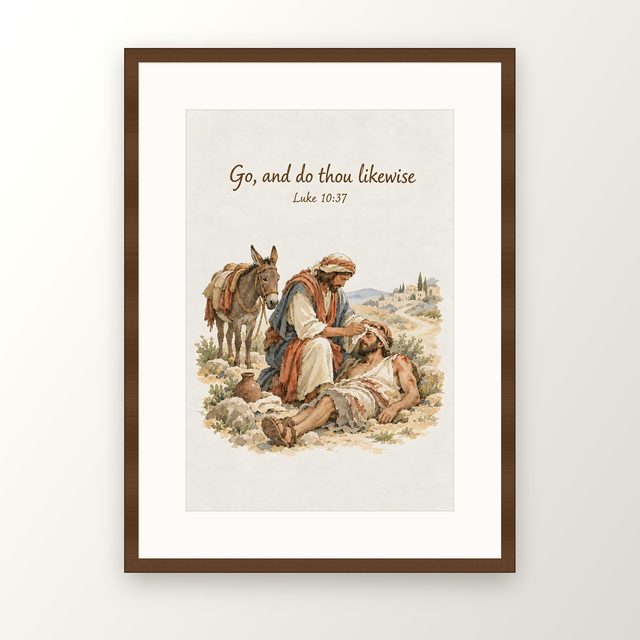
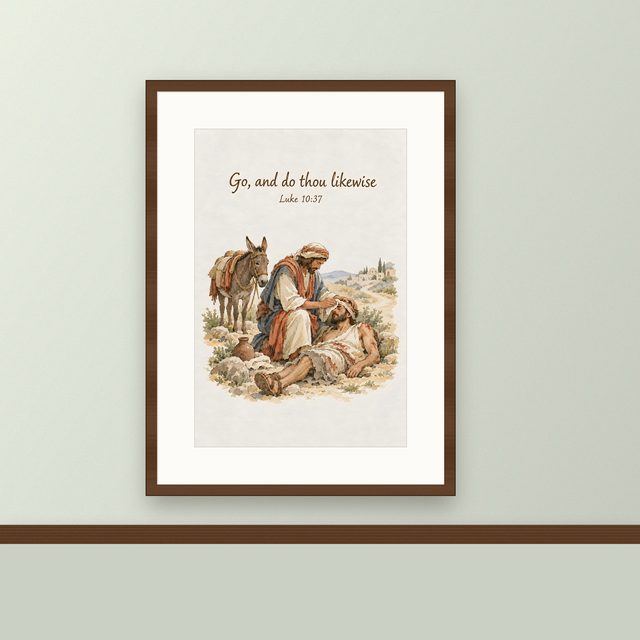
Luke 10 · King James Version
37 Go, and do thou likewise
The question behind the story
Luke 10 begins with Jesus sending out seventy disciples ahead of him, two by two. Then a lawyer, an expert in the law of Moses, stands up to test him: what must he do to inherit eternal life? Jesus asks him what the law says, and the lawyer answers well by joining two commands of the Torah (Deuteronomy 6:5 and Leviticus 19:18): wholehearted love for God, and love for your neighbor as for yourself.
Wanting to justify himself, the lawyer asks a second question, the one the parable answers: and who is my neighbour?
What does “Go, and do thou likewise” mean?
A man travels down from Jerusalem to Jericho, a road that drops roughly three thousand feet through bare desert hills and was notorious for bandits. He is robbed, stripped and left half dead. A priest comes by and passes on the other side; so does a Levite, a temple assistant. Both were respected religious figures.
The third traveler is a Samaritan. Jews and Samaritans had centuries of hostility between them, disagreeing about the right place to worship, and John 4:9 notes that they had no dealings with each other. The Samaritan bandages the wounds, pours in oil and wine, puts the man on his own animal, pays the innkeeper two pence and promises to cover any further cost.
Jesus then turns the lawyer's question around. He does not ask who deserves to be treated as a neighbor, but which of the three proved to be a neighbor. The lawyer, perhaps unable to say the word Samaritan, answers, “He that shewed mercy on him.” Jesus replies, Go, and do thou likewise. The point is not to define the edges of duty but to become the kind of person who stops.
Hospitals, laws and everyday kindness
The parable has left marks everywhere: Good Samaritan hospitals, charities and the Good Samaritan laws in every American state that protect people who help in an emergency. A Luke 10:37 print is a natural gift for a nurse, a doctor, a volunteer, a social worker or anyone who has quietly stopped on the road for someone else.
Martha, Mary and mercy elsewhere
The chapter ends at the home of Martha and Mary, where Mary sits listening at Jesus's feet while Martha is busy serving; placed right after the Samaritan, the scene balances doing with listening. Mercy as the true test of faith runs through Scripture, from Micah 6:8, which asks what the LORD requires, to the parable of the sheep and the goats in Matthew 25.