Bible verse wall art
Psalm 121: I will lift up mine eyes unto the hills
A traveler's psalm, sung on the road to Jerusalem. It begins by looking at the hills and ends by looking past them, to the one who made them.
Psalm 121 prints
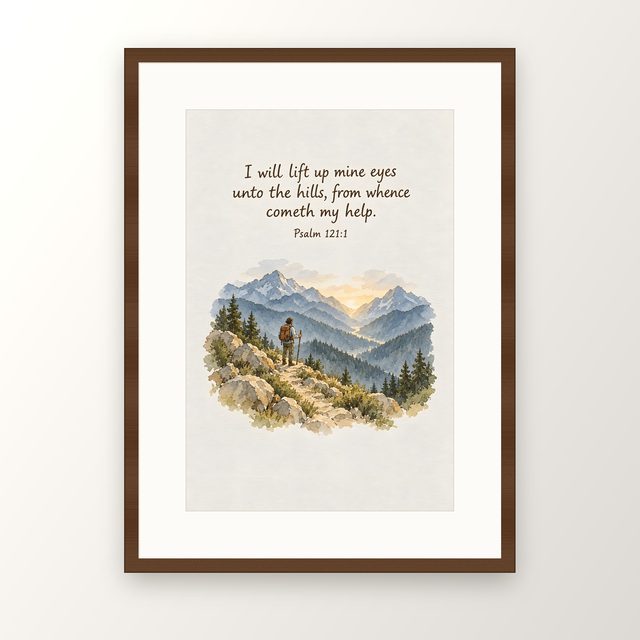
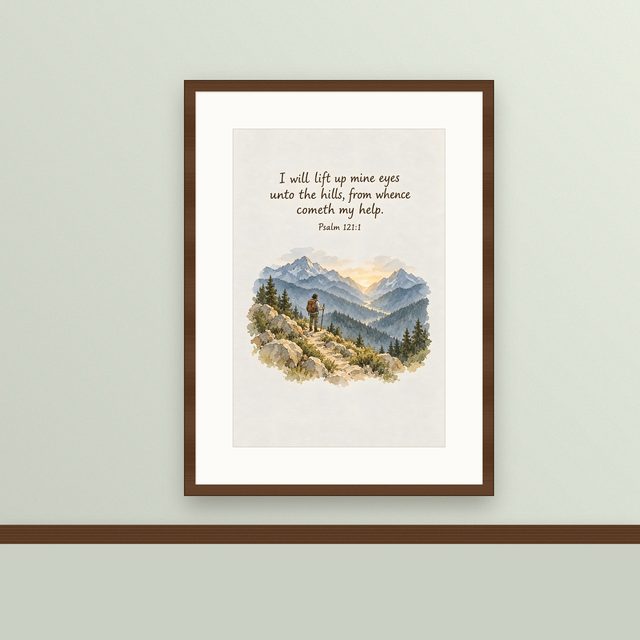
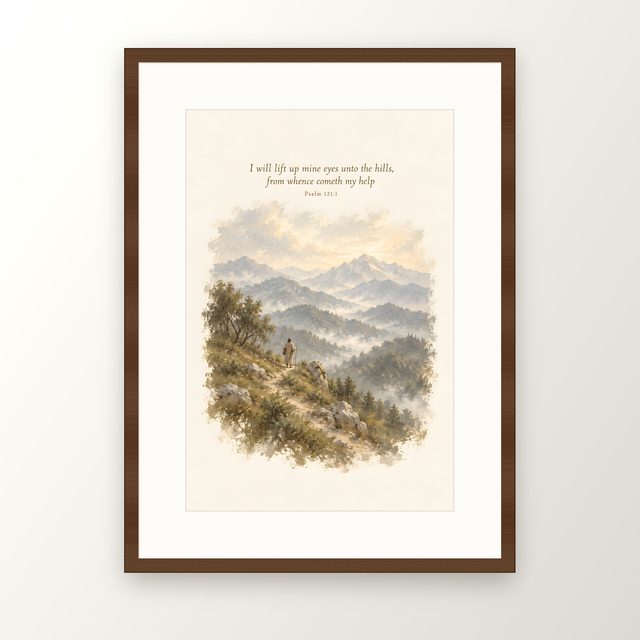
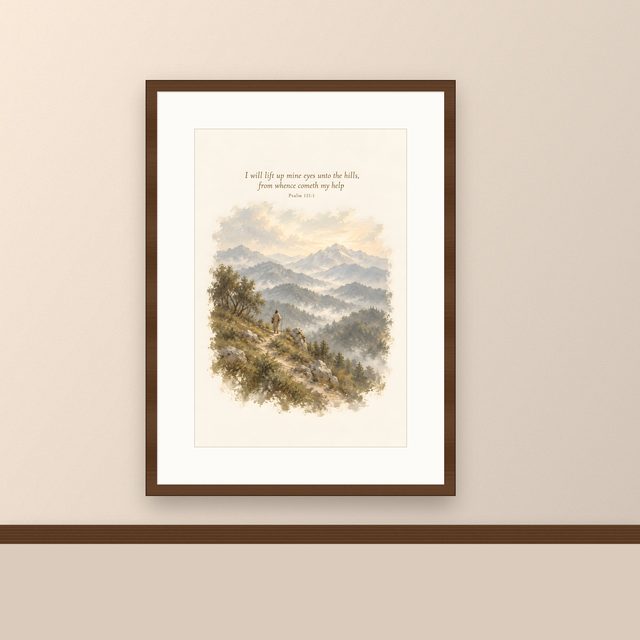
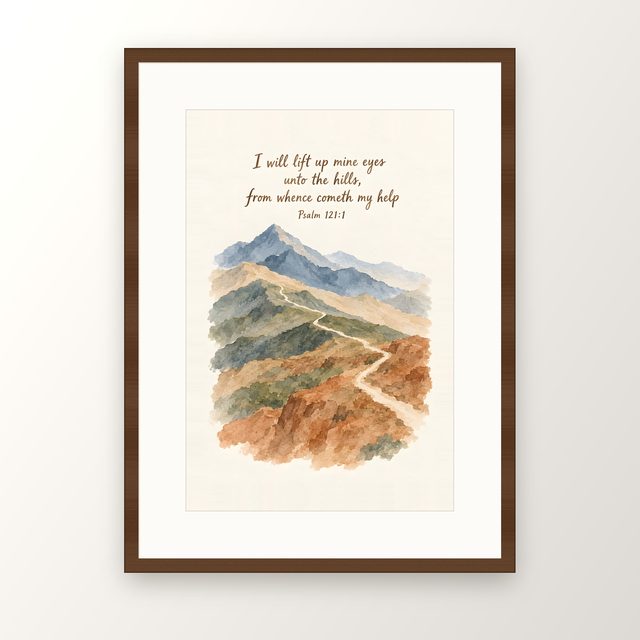
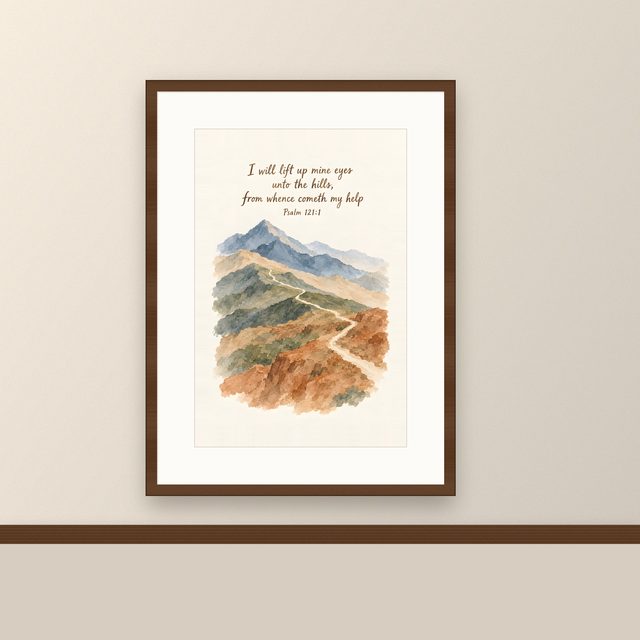
Psalm 121 · King James Version
1 I will lift up mine eyes unto the hills, from whence cometh my help.
A song of degrees
Psalms 120 to 134 each carry the heading “A Song of degrees”, often translated Song of Ascents. They are widely understood as songs for pilgrims going up to Jerusalem for the great feasts, a climb that from almost any direction means going uphill. They are short, easy to remember and full of the details of travel: feet, sleep, sun, the gates of the city.
What does Psalm 121:1 mean?
“I will lift up mine eyes unto the hills, from whence cometh my help.” In the King James the second half reads as a statement. Most modern translations make it a question, “where does my help come from?”, and the next verse answers it: “My help cometh from the LORD, which made heaven and earth.”
Either way, the hills are not themselves the help. For a pilgrim they could mean danger, since bandits waited on remote paths, and they were also where local shrines to other gods stood. The psalmist looks up at them and then looks higher, to the Maker of the hills.
The Lord who keeps
One Hebrew verb, shamar, to keep or guard, appears six times in eight verses. “He that keepeth thee will not slumber” (121:3). “Behold, he that keepeth Israel shall neither slumber nor sleep” (121:4). He is a shade at the right hand, so that the sun does not strike by day nor the moon by night.
The last verse gathers the whole journey into one promise: “The LORD shall preserve thy going out and thy coming in from this time forth, and even for evermore” (121:8). Leaving home and coming back, and everything between.
A psalm for journeys and for goodbyes
Because of that ending, Psalm 121 is read before long trips, at the sending of missionaries and soldiers, and when children leave for college. It is also one of the psalms most often chosen for funerals, where the final going out is in view. Hikers and anyone who lives within sight of mountains tend to make it their own.