Bible verse wall art
Psalm 150: let every thing that hath breath praise the Lord
The book of Psalms ends with six verses of pure praise. No complaint, no enemy, no request: only instruments, dancers, and finally every living creature joining in.
Psalm 150 print
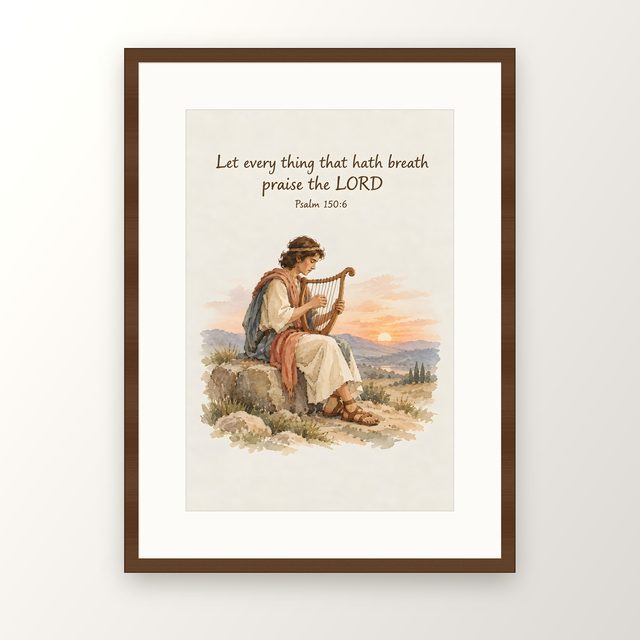
Psalm 150 · King James Version
6 Let every thing that hath breath praise the LORD
The final doxology
The Psalter is divided into five books, and each of the first four ends with a short blessing of God. Psalm 150 closes the fifth book and the whole collection. It carries no heading and names no author. It simply says “Praise” thirteen times in the King James wording, beginning and ending with “Praise ye the LORD”, which translates the Hebrew hallelu-jah.
An orchestra in six verses
Verse 1 says where God is praised: in his sanctuary and in the firmament of his power, on earth and in heaven. Verse 2 says why: for his mighty acts and his excellent greatness. Then verses 3 to 5 name the instruments of ancient Israel one after another. Trumpet, psaltery and harp, timbrel and dance, stringed instruments and organs (probably pipes or flutes), loud cymbals and high sounding cymbals.
The list mixes the Temple instruments played by priests and Levites with the hand drums and dancing that belonged to village celebrations. Worship here does not belong only to professionals.
What does Psalm 150:6 mean?
“Let every thing that hath breath praise the LORD. Praise ye the LORD.” After all the instruments comes the one thing every creature already has. Breath recalls Genesis 2, where God breathes into Adam the breath of life. The same breath that keeps us alive is meant to return to the one who gave it, as praise.
The verse is also generous. It does not say every believer, or every skilled musician. It says every thing that has breath, which takes in the whole animal world and every human being, a vision close to the song of every creature in Revelation 5:13.
David, music and the church
Psalm 150 names no author, but it is natural to picture David playing, since Scripture remembers him as the young harpist whose music calmed King Saul (1 Samuel 16:23) and tradition links many psalms to him. Composers have loved this text: Stravinsky set it in the last movement of his Symphony of Psalms, and Bruckner and César Franck wrote choral settings. A print of verse 6 suits a music room, a choir loft, a piano teacher's studio or a worship leader's office.