Bible verse wall art
Psalm 103: the Lord is merciful and gracious
A psalm with no requests in it at all, only thanks. David talks to his own soul and tells it to remember, and at the center he repeats a sentence first spoken on Mount Sinai.
Psalm 103 print
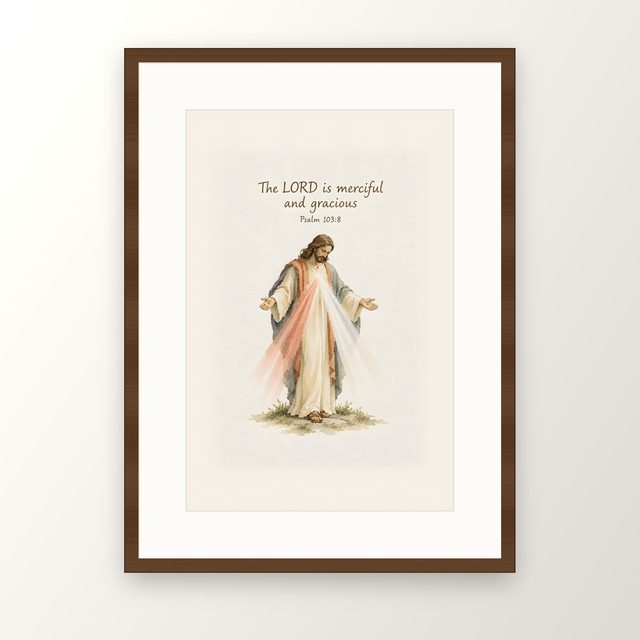
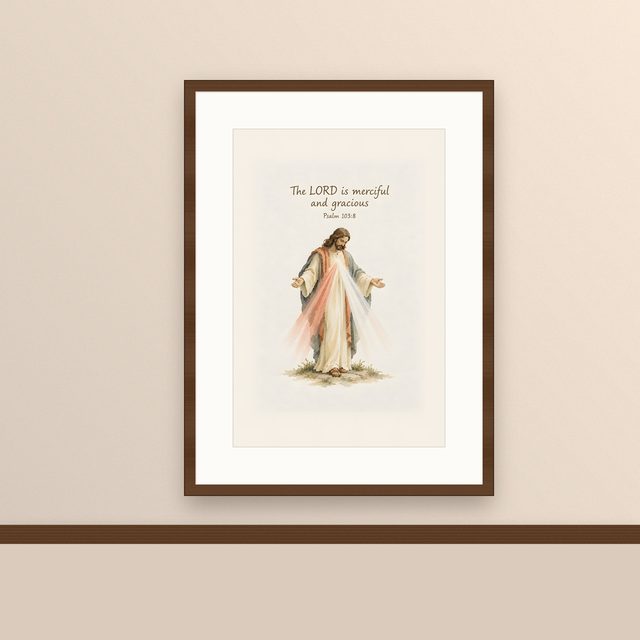
Psalm 103 · King James Version
8 The LORD is merciful and gracious
Bless the Lord, O my soul
The heading reads “A Psalm of David”. It begins and ends with the same command, addressed inward: “Bless the LORD, O my soul: and all that is within me, bless his holy name” (103:1). Verse 2 adds “forget not all his benefits”, and the list follows: forgiveness, healing, rescue, a life crowned with kindness, strength renewed like the eagle's.
Henry Francis Lyte turned the psalm into the hymn “Praise, my soul, the King of heaven”, which is still sung at weddings and royal occasions in the English-speaking world.
The meaning of verse 8
“The LORD is merciful and gracious, slow to anger, and plenteous in mercy.” These words are not new with David. When God passes before Moses on Sinai after the golden calf, he describes himself as merciful and gracious, longsuffering and abundant in goodness (Exodus 34:6). The same formula then comes back across the Old Testament, in Nehemiah, Joel, Jonah and several psalms. It is the closest the Hebrew Bible comes to a creed about God's character.
The verses that follow explain what it means in practice. God will not keep his anger for ever. “As far as the east is from the west, so far hath he removed our transgressions from us” (103:12). “Like as a father pitieth his children, so the LORD pitieth them that fear him” (103:13).
Why it pairs with Divine Mercy
The Divine Mercy devotion began with Saint Faustina Kowalska, a Polish nun who in the 1930s described a vision of Christ with two rays, one red and one pale, streaming from his heart. The image carries the words “Jesus, I trust in You”, and Pope John Paul II made the Sunday after Easter Divine Mercy Sunday in 2000. Psalm 103:8 is the Old Testament language for the same thing that image was painted to say.
At funerals and in hard seasons
The second half of the psalm is often read at funerals. Man's days are as grass, a flower that the wind passes over, but “the mercy of the LORD is from everlasting to everlasting upon them that fear him” (103:17). For anyone carrying guilt or grief, verse 8 is a short sentence worth keeping in sight.