Bible verse wall art
Psalm 19: the heavens declare the glory of God
A psalm in two halves: first the sky, then the Scriptures. It moves from what anyone can see on a clear night to what can only be read, and finds the same God in both.
Psalm 19 print
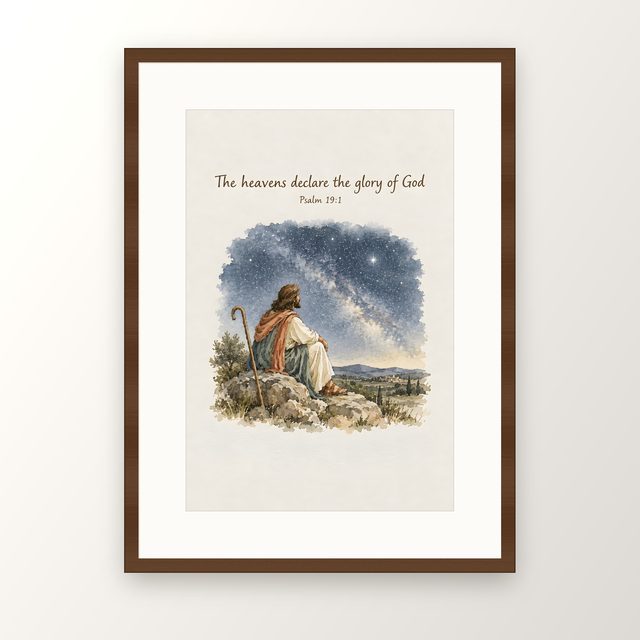
Psalm 19 · King James Version
1 The heavens declare the glory of God
A poem admired by poets
Its title dedicates it to the chief Musician and names David. C. S. Lewis called it the greatest poem in the Psalter and one of the greatest lyrics in the world. Haydn built one of the most famous choruses of his oratorio The Creation, “The Heavens Are Telling”, on its opening lines.
What does Psalm 19:1 mean?
“The heavens declare the glory of God; and the firmament sheweth his handywork.” The firmament is the vault of the sky as it appears from the ground. The verb “declare” means to recount or tell over, as one tells a story. The sky is pictured as a messenger that never stops talking about its Maker.
Verses 2 and 3 add a paradox. “Day unto day uttereth speech, and night unto night sheweth knowledge. There is no speech nor language, where their voice is not heard.” Many readers take the second line to mean that the heavens speak without any words at all, and yet everyone hears them. Their message crosses every border. Paul quotes the next verse in Romans 10:18 to say that the gospel has gone out to the ends of the world.
Verses 4 to 6 then follow the sun across the sky, coming out like a bridegroom from his chamber, running its course like a strong man in a race.
From the sky to the Scriptures
At verse 7 the poem changes subject without warning: “The law of the LORD is perfect, converting the soul.” Six lines describe God's law, testimony, statutes, commandment, fear and judgments, and call them more to be desired than gold, “sweeter also than honey and the honeycomb” (19:10). The same God who wrote in light across the sky has spoken in words, and the second kind of speech is more personal than the first.
A prayer before sermons
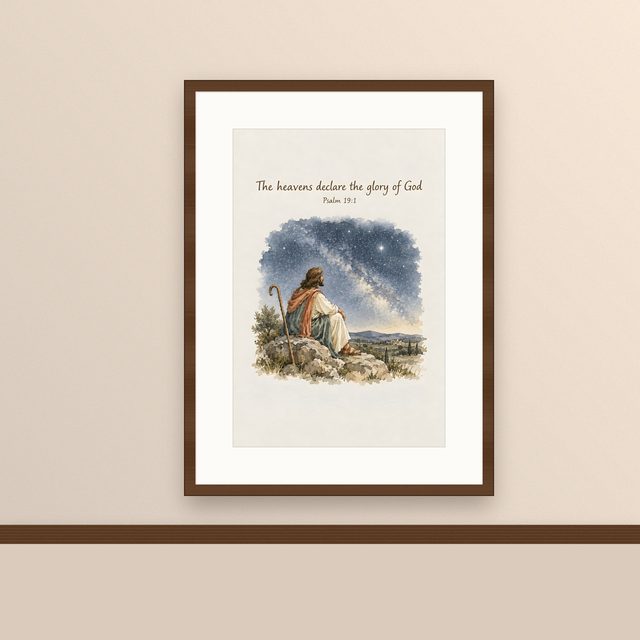
The psalm ends with a line many preachers pray before they begin: “Let the words of my mouth, and the meditation of my heart, be acceptable in thy sight, O LORD, my strength, and my redeemer” (19:14). Verse 1, for its part, belongs wherever people look up. It is a favorite of amateur astronomers, campers and ranchers, and a natural choice for a child who asks questions about the night sky. Our painting imagines a young shepherd, perhaps David himself, sitting beneath the Milky Way.